


Real Account vs. Prop Firm Trading: Which Path to Financial Freedom Fits You Best?
In recent years, proprietary trading has garnered significant attention from investors. Traders often face two choices: trading with their own funds in traditional trading platform or participating in proprietary trading challenges to earn profits. Both approaches offer distinct benefits and challenges, and understanding these differences is essential for aligning your trading goals with the most suitable path.
Trading with Your Own Account
Real Experience and Skill Development
Trading with a personal account provides unmatched hands-on exposure to financial markets. This real-world experience is invaluable for developing essential trading skills:
Risk Management: Learning to manage position sizes and protect capital.
lEmotional Control: Confronting and mastering emotions like fear and greed, which are absent in demo environments.
Decision-Making: Building confidence in executing strategies and adapting to changing market conditions.
As one trader noted, “leaving the computer when your idea fails is by far the hardest thing in trading…something you have to master if you want to be pro.”
Financial Empowerment
Unlike prop trading, where profits are shared, trading with your own account allows you to keep 100% of your earnings. This autonomy is motivating, providing a direct link between effort and reward.
Independence and Control
One of the most significant advantages of a real account is full autonomy. Traders can:
Choose strategies, risk levels, and trading frequency without constraints.
Make decisions based on personal research and analysis, adapting quickly to market changes.
Prop Firm Trading: A Double-Edged Sword
The Appeal of Funded Trading
Prop firms offer traders access to large pools of capital, reducing the need for personal funds. This can be enticing for individuals looking to scale quickly. However, this opportunity comes with stringent requirements, including profit targets and strict risk management rules.
For many traders, the appeal lies in the possibility of learning discipline through these challenges. As one trader reflected:
“I spent nearly a year trying to complete a challenge account… I do believe it helped me in the long run because it made me realize how difficult trading is and I learned so much.”
Challenges and Risks
While funded trading programs can be beneficial, they also come with notable downsides:
High Costs: For traders who repeatedly fail the challenge, there may be a high challenge fee.
Restrictive Rules: Many programs have strict guidelines, such as daily loss limits, which can add psychological pressure.
Unfair Practices: Some traders report payout rejections or account shutdowns without clear reasons.
Promotion of Risky Behavior: The pressure to meet profit targets can lead to overtrading or revenge trading.
One experienced trader described the system as “casino-like, with rules and gotchas designed to screw over people.”
Trader Perspectives
1. High Fees and Hidden Costs: “You’re charged insanely high commissions on orders that never go to any exchange. This type of system promotes gambling-like behavior.”
2. Learning Opportunities: For beginners, funded programs can serve as a low-cost introduction to trading, provided expectations are managed. “My advice to new traders: try the lowest account size if you want, but don’t expect to pass. Use it as an experience to learn trading.”
3. Evolution of Strategy: Many traders refine their risk tolerance and strategies through repeated attempts, highlighting the value of persistence and self-discipline.
Key Difference:
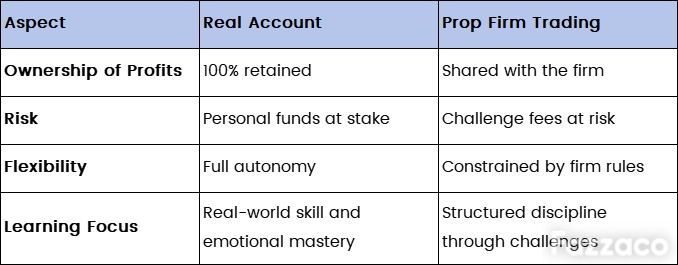
Selecting to trade with a real account or trade through a prop firm depends on your financial resources, risk tolerance, and trading goals. A personal account provides unmatched independence, profit retention, and exposure to diverse markets, making it ideal for those ready to take full control.
Prop firms, on the other hand, can be a stepping stone for those who want to gain experience with less initial capital. However, the limitations and risks, such as repeated fees and restrictive rules, must be carefully considered.
Ultimately, understanding your objectives and trading style will guide you to the best approach for your trading journey.
 Subscribe Now

