


Regulator Analysis: Choosing the Right Offshore Jurisdiction for Your Brokerage Business
Over the years, the forex industry has seen an increasing number of brokers switching to seek offshore regulation, as the European Securities and Markets Authority (ESMA) has clamped down on regulations, and other regulatory bodies such as the Australian Securities and Investments Commission (ASIC) also followed the footstep.
Indeed, it brings forex companies much more freedom, less application fees and operation cost to head for a jurisdiction that offers much looser regulation. Under such loose jurisdiction, brokerage firms are able to offer more flexible trading leverage, which are allowed in some regions to be as high as 500:1, 300:1, 200:1, and richer trading instruments, enabling customers to have the opportunity to enjoy a larger return of investments.
Apart from that, it takes approximately only 2-3 months to secure the license from offshore regulation bodies, compared to 6-12 months from the UK Financial Conduct Authority (FCA).
Currently, the major jurisdictions providing offshore regulation include the Cayman Islands, Mauritius, Vanuatu, Seychelles, Belize, and British Virgin Islands.
Following are the advantages and some special requirements for applying for a license from or registering with the regulators in the above mentioned areas:
The Cayman Islands Monetary Authority (CIMA)
The Cayman Islands is 1/4 the size of Hong Kong, however, it is the fifth largest financial center in the world, only second to London, New York, Hong Kong and Tokyo. The number of companies registered in the country exceeds 100,000, including more than 700 banks, 800 insurance companies and nearly 10,000 hedge fund institutions.
The Cayman Islands does not impose any direct taxes on either individuals or companies, because it was forever exempt from tax obligations by the UK Royal Decree. As a result, hundreds of thousands of companies from all over the world have chosen this region as their domicile, including some of the world's most well-known companies such as Apple, Microsoft, Google, Intel and Coca-Cola.
Currently, CIMA has entered into bilateral and multilateral memorandums of understanding with dozens of countries and regions, including the United States, Canada, the Caribbean, the United Kingdom, and South America, which indicate directly CIMA's key part in the international financial services field.
The Vanuatu Financial Services Commission (VFSC)
Vanuatu has a fully liberalized economy with no income tax, no restrictions on the movement of funds in and out of the country, no currency controls. Overseas merchants who set up their own business in this country are able to enjoy a low cost, and their companies are protected by the local laws.
Today, many of the world's top brokers such as Interactive Brokers, Saxo Bank and LEK (Lek Securities) have registered with VFSC. Companies holding a license granted by VFSC are starting to gain widespread recognition.
However, the regulatory body requires the applicant company to have a local physical office and the license issued will be revoked if the authorized company does not provide related services within 6 months.
The Belize International Financial Services Commission (IFSC)
IFSC is an active member of the Caribbean Financial Action Task Force (CFATF), working to eliminate money laundering and maintain regional financial stability under the global financial ecosystem. Additionally, it has formed partnerships with several countries to better regulate the forex futures market.
As for the income from outside Belize, brokers in the region don’t have to pay local income tax. Also, documents need submitting are relatively fewer for applicant firms compared with that of other offshore regulators. Furthermore, the country is not inclined to disclose corporate banking or financial information.
The Seychelles Financial Services Authority (FSA)
Seychelles is regulated by the Seychelles International Business Authority, committed to becoming an international financial center in Africa, with a focus on offshore financial services.
Companies licensed by the FSA are entitled to a tax credit (1.5% of annual income), no limit on the number of clients they can accept, and the ability to trade securities using nostro accounts or as introducing brokers.
Seychelles FSA requires applicant companies to open a local bank account and deposit $50,000 in equity capital, which can be used for their daily business activities without the need to deposit margin in the bank. In addition, a local physical office is required.
The British Virgin Islands Financial Services Commission (FSC)
The BVI FSC is the authoritative regulatory body for all financial services companies operating in British Virgin Islands. The Commission requires applicant companies to launch a local physical office, to have permanent staff in that office, and to appoint at least one shareholder and one director. A person can serve as a shareholder and a director of the company at the same time.
The Mauritius Financial Services Commission (FSC)
The Mauritius FSC, the watchdog focused on the non-banking financial services sector and global operations, is rapidly developing into an internationally recognized financial regulator with a strong legal framework.
Companies licensed by the FSC in Mauritius are exempt from stamp duty, registration tax or other such fees, and royalties paid to non-residents are tax-free. Moreover, the Commission does not disclose companies' financial statements publicly.
The Labuan Financial Services Authority (FSA)
The Malaysian government declared Labuan as a free port and international offshore financial center in 1990, allowing international natural or legal persons to engage in various offshore businesses in the region.
To attract foreign investment to develop the country’s economy, Labuan offers low taxes (only 3% tax on audited net profits) or tax exemption policies (no stamp duty, tax on consumption, import and export, sales, service, capital gains, and inheritance, etc.) to inject impetus into offshore financial field. Foreign companies that obtain a Labuan FSA license can enjoy 100% ownership without a Malaysian partner, and will gain more than 70 tax treaty partners in this country. Meanwhile, the financial regulator requires applicant companies to launch a physical office in the local country.
Application Fees and Capital Requirements for A Financial Service License from the 7 Offshore Regulators
Regarding the application fees and capital requirements for the financial service license from the 7 offshore regulators, the specifics are as follows:
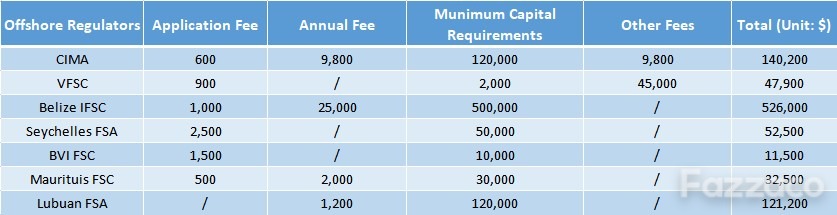 From the chart above, we get the knowledge that the BVI FSC requires the most favorable and competitive cost and capital totalling US$32,500, while Belize requires US$514,500 higher. However, compared to that of the US at $20 million and of Europe at $827,000, we will know how minuscule the above amounts are.
In light of the aforesaid information, we get a picture that compared to the mainstream regulation, offshore regulatory licenses do provide a lot of advantages and convenience for the forex companies. As companies holding offshore licenses have a larger impact on the world economy, the offshore financial centers are tightening regulations step by step. They enact much more stringent laws against overseas companies, require more specific financial information, and separation company capital from that of customers, etc. In the meantime, a larger number of offshore regulatory bodies require the applicant company to set up a physical office in the local region, such as currently the VFSC, Seychelles FSA, British Virgin Islands FSC and Labuan FSA.
Whereas, the offshore regulation has been questioned by the industry all the time, as the relative laxity of the offshore regulation is more likely to lead brokers to commit illegal oparations, which pose a potential capital security risk for investors.
The top priority for investors is the safety and reliability of a trading platform, and supervision is the last firewall. Hence, Fazzaco would like to remind all brokers that while they are enjoying the great advantages brought by offshore regulation, it is crucial to operate in line with the rules. Otherwise they will lose investors' trust and eventually make it tougher for brokers with offshore regulatory licenses to cast off the unreliable image.
 Subscribe Now

