


Saxo Data Highlights Stronger Performance from Multi-Product Investors

Saxo Bank has published aggregated client data comparing the performance of investors who traded a single product with those who traded multiple asset classes, revealing notable differences in outcomes over time.
The analysis covers a five-year period from 2021 to 2025 and is based on anonymised results from Saxo’s client accounts. According to the data, investors who traded more than one product were more likely to achieve stronger average performance, reinforcing the benefits of diversification.
Saxo said the findings highlight the importance of spreading risk across different instruments, noting that clients with multi-product strategies generally outperformed those focused on a single market.
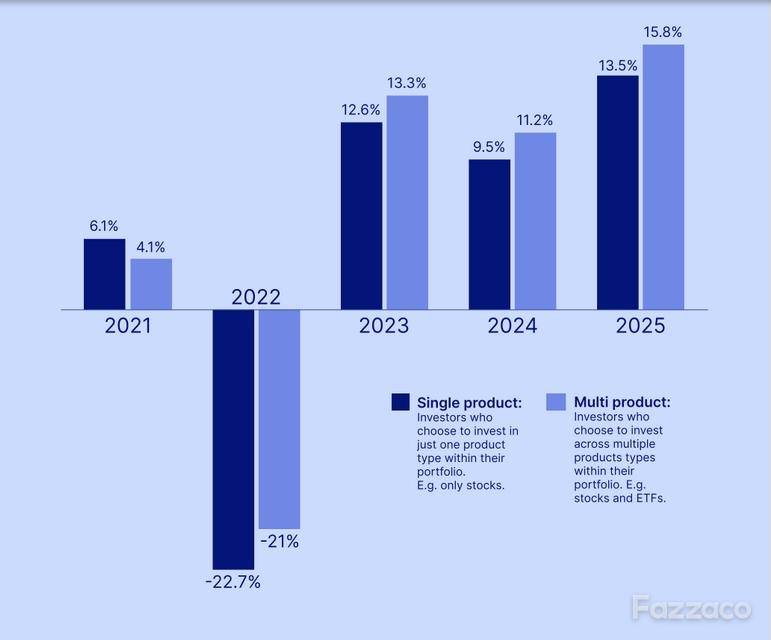
Performance varied across individual years. In 2021, single-product investors posted higher average gains of 6.1%, compared with 4.1% for multi-product investors. Market conditions deteriorated sharply in 2022, with both groups recording losses, although multi-product investors experienced smaller declines, losing 21% versus 22.7% for single-product traders.
Returns recovered in 2023, with multi-product investors slightly outperforming at 13.3%, compared with 12.6% for single-product investors. The performance gap widened further in 2024, when multi-product investors achieved average returns of 11.2%, versus 9.5% for those trading a single product.
In 2025, both groups delivered stronger results, led once again by multi-product investors, who recorded gains of 15.8%, compared with 13.5% for single-product investors.
Overall, investors trading multiple products outperformed in three of the five years analysed and showed greater resilience during periods of market stress.
Saxo attributed the trend to evolving retail investor behaviour in Europe and Asia, where portfolios increasingly combine equities, exchange-traded funds (ETFs), options, foreign exchange and, in some cases, digital assets.
The firm also pointed to the impact of prolonged low interest rates, which encouraged investors to seek alternatives beyond traditional savings products. At the same time, tighter European regulations on leverage, transparency and client protection have reduced the appeal of lightly regulated offshore brokers, favouring fully regulated institutions offering multi-asset investment access.
 Subscribe Now