


Spotware cTrader Broker Technology: Platform, Copy, Algo and cBridge | B2B Guide
Spotware and cTrader: a B2B guide to the trading platform ecosystem
Spotware Systems develops trading software for FX/CFD brokers and proprietary-trading businesses. Its flagship cTrader is more than a retail-facing terminal: the company's current product material describes client applications, broker administration, server infrastructure, APIs, copy trading, algorithmic trading and partner tools. Spotware also markets cBridge as a separate liquidity-bridge product. For a broker selecting technology, the useful question is not whether these components appear in one product catalogue, but which are included in the proposed deployment and how they connect to the broker's existing execution, CRM, payments and compliance systems.
This Fazzaco company introduction uses Spotware's official website, its cTrader product page and cBridge page, checked on 27 September 2026. Product descriptions are attributed to the vendor; the buyer questions and analysis are Fazzaco editorial work, not claims of a live product test. Fazzaco's directory lists Spotware in trading-software and copy-trading categories. It is not presented there as a forex broker or cryptocurrency exchange.

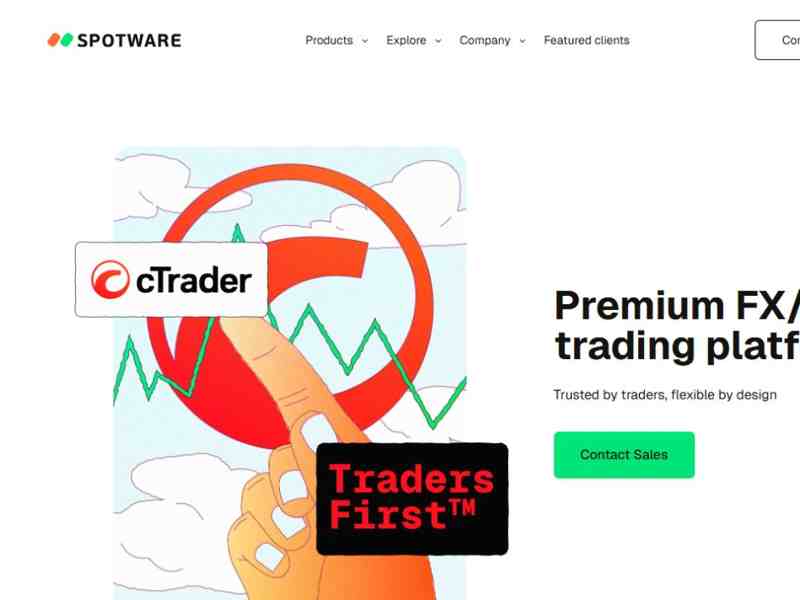
Spotware official homepage, captured 27 September 2026.
What sits inside the cTrader proposition?
Spotware presents cTrader as an FX/CFD platform serving brokers, traders and introducing partners. Its official page describes web and mobile applications plus Windows and Mac clients. The broker-facing suite includes cTrader Admin, cTrader Server, APIs, plugins, widgets and integrations. Trader-facing products include charting, trading tools, cTrader Copy, cTrader Algo and access to the cTrader Store. cTrader Invite is positioned as a referral toolkit for introducing brokers. Each layer supports a different workflow and may have different licensing, implementation and support boundaries.
A buyer should start by asking the vendor to draw the complete proposed architecture. Which components are hosted by Spotware, the broker or another supplier? Where do prices enter, where is margin calculated, and which system records the authoritative balance and order history? How do a CRM, client area, payment provider, liquidity bridge and reporting system interact with cTrader? A platform demonstration can look coherent while those integration boundaries remain unresolved. The architecture and responsibility matrix should be signed off before a migration plan or launch date is accepted.
| Component | Vendor-described role | Procurement check |
|---|---|---|
| cTrader applications | Trader experience across web, desktop and mobile | Supported instruments, account flows, localization and client support |
| cTrader Admin and Server | Broker control and core platform operations | Roles, configuration rights, audit trails and recovery responsibilities |
| cTrader Copy and Algo | Strategy following and automated trading tools | Eligibility, risk controls, disclosures and operational monitoring |
| APIs, plugins and widgets | Third-party connection and interface extension | API limits, security, versioning and upgrade compatibility |
| cTrader Invite | Partner referral tooling | Attribution rules, data ownership and commission reconciliation |
| cBridge | Separate liquidity bridge and routing product | Platform/protocol scope, rule design, pricing and incident ownership |
cTrader official product page, captured 27 September 2026.
Trader experience should be tested as a workflow
A trading platform affects acquisition, activation, everyday dealing and support. Spotware's page highlights order tools, charts, alerts and cross-device availability. A broker should assess those claims with its own instruments and account states, not a generic showcase. Begin with registration, funding and first trade; then test a partial fill, an order rejection, a margin warning, a server interruption and a statement dispute. Check that client-facing messages are understandable and that the same event is visible to support and dealing teams.
Mobile and desktop parity is particularly important when a broker offers advanced order types or algorithmic tools. Test how watchlists, chart layouts, indicators and trade history synchronize between devices. Confirm which functions are native to each client and which require plugins or a particular deployment. Local-language coverage should be evaluated in menus, transactional messages, disclosures and support material, not merely counted from a marketing claim about translated interfaces.
For a white-label rollout, separate visual branding from business-rule customization. A logo and color scheme may be straightforward, while symbol setup, fee schedules, margin rules, client segmentation and regional compliance require deeper configuration. Ask what can be changed by authorized broker staff, what needs Spotware support and what is treated as custom development. This distinction determines how quickly the broker can respond to market or regulatory changes after launch.
Execution and liquidity connections
Spotware's product material describes an open platform with integrations and APIs. These are potential ways to connect a broker's pricing, liquidity, risk and reporting stack, but a named integration does not prove that every version, market or legal entity is ready to transact. Buyers should request current documentation for each required connection, including authentication, message formats, rate limits, error handling, testing environment and change-notification policy.
An execution review should trace a quote from its provider to the cTrader client, then follow an order through validation, routing, confirmation, ledger update and client statement. Capture timestamps and identifiers at each handoff. Use both ordinary flow and exception cases: stale quotes, price gaps, partial fills, rejected hedges and network failover. The broker should know who owns an incident when the client interface, bridge, liquidity provider and back office show different states.
cBridge is a distinct product decision
cBridge is marketed as a liquidity bridge that supports cTrader, MetaTrader 4, MetaTrader 5 and FIX API connections. Spotware describes infrastructure-based fixed fees rather than volume-based charges, dealer-oriented routing configuration and monitoring dashboards. Those are vendor descriptions. Public savings estimates are not evidence of the cost or execution quality a specific broker would obtain.
When evaluating cBridge, the broker should supply a routing policy and ask the vendor to implement it in a sandbox. Test provider priority, symbol mapping, client-group segmentation, markups, exposure limits, last-look handling where relevant, and failover. Review how a dealer can explain a rule, who can edit it, whether changes require approval and how prior configurations are restored. Request sample reports covering fill ratios, reject reasons, slippage and latency distributions for the broker's own test traffic.
Commercial comparison also needs a complete cost model. Fixed bridge fees may make one cost line more predictable, yet total spend can still include servers, data centers, platform licenses, market data, connectivity, implementation, support and third-party services. Put these items into a multi-year scenario using realistic message volumes and growth assumptions. The cheapest bridge quote is not necessarily the least costly operational design.
Copy trading, algo tools and partner distribution
cTrader Copy brings strategy providers and followers into the same platform environment. This can broaden the broker's product offering, but it creates decisions about who may publish a strategy, how risk and performance are displayed, whether copied positions are executed under the same conditions, and what happens when a strategy or provider is suspended. A buyer should review suitability and disclosures with its legal and compliance teams for each market served.
cTrader Algo and the Store make third-party or user-built trading tools more accessible. That increases extensibility but also changes the security and support model. Ask which code runs locally or in the cloud, how permissions are granted, how updates are reviewed, and whether the broker can restrict tools that create unacceptable order patterns or data access. Stress-test automated order bursts and recovery after a disconnection. Vendor language about ease of use is not a substitute for operational controls.
The cTrader Invite toolkit is aimed at introducing brokers and other partners. Referral links and real-time statistics may simplify distribution, but attribution and payment still require a clear rulebook. Confirm how duplicate referrals, chargebacks, client moves between partners and multi-brand accounts are handled. Reconcile partner-facing reports against the broker's CRM and finance ledger before commissions become payable.
Prop-firm use cases are not identical to a brokerage
Spotware markets cTrader to proprietary-trading firms as well as brokers. Prop businesses may need challenge stages, simulated or live-account transitions, rule-breach detection, payout controls and different CRM or risk integrations. A platform supporting FX/CFD execution does not automatically provide a complete challenge-management stack. A prop-firm buyer should ask which processes are native, which come from third parties and which require custom configuration.
Use a complete participant lifecycle as the test: registration, challenge purchase, account creation, rule monitoring, pass/fail decision, funded stage, payout request and dispute. Require an audit trail for each decision and ensure that marketing claims about launch speed match the scope actually agreed in the implementation plan. The institution operating the prop programme remains responsible for its own rules, disclosures and customer communications.
Implementation, security and operating control
A platform migration should be divided into data mapping, integration, parallel running, cutover and post-launch stabilization. Map client profiles, balances, open positions, order history, consents and support records. Establish who signs off each dataset and what threshold triggers rollback. Test under normal and volatile market conditions, with realistic client-device traffic. Broker teams need training on permissions, incident triage, reconciliation and release management before switching live accounts.
Ask Spotware for the current security and resilience materials relevant to the contracted services, then have the broker's own security team assess them. The due-diligence pack should cover identity management, privileged access, encryption, audit logging, data location, backups, recovery tests, vulnerability handling and third-party dependencies. Request contractual definitions of availability, severity levels, escalation, maintenance windows and data export at exit. Public descriptions of reliable infrastructure cannot replace these documents.
How a broker should compare Spotware with alternatives
Every shortlisted platform should receive the same anonymized client accounts, symbols, order scenarios and integration requirements. A proof of concept should include a front-end user journey, a dealing-desk workflow, a liquidity outage, a reporting reconciliation and a controlled release. Document pass/fail criteria in advance. The review should involve dealing, technology, risk, compliance, finance, marketing and client support because each team sees a different part of the platform's value and cost.
| Area | Evidence to request |
|---|---|
| Functional fit | Demo with the buyer's instruments, account types and exception cases |
| Architecture | Product-edition map, data flows, APIs and responsibility matrix |
| Execution | Order-flow logs, routing tests, reconciliation and incident replay |
| Operations | Role matrix, support workflow, release process and recovery test |
| Commercial scope | Setup, recurring, bridge, hosting, data, support and exit costs |
| Migration | Data mapping, parallel run, cutover criteria and rollback plan |
Spotware can be relevant to brokers looking for a multi-device FX/CFD platform with an extensible ecosystem and to prop firms evaluating trading technology. The case for it depends on the exact cTrader and cBridge configuration, integration effort, operating responsibilities and commercial terms. Fazzaco has not independently measured platform performance or verified client returns. The next step is a scoped demonstration and contract review against the prospective buyer's own business model.
Frequently asked questions
Is Spotware itself a forex broker?
No. Spotware describes itself as a platform and software provider. Fazzaco lists it in trading-software and copy-trading categories, not the Forex Brokers category.
Is cBridge automatically part of every cTrader deployment?
Do not assume so. cBridge is described on a separate product page. Confirm the licensed components, pricing and support boundaries in the specific proposal.
Can a broker connect cTrader to existing systems?
Spotware describes APIs, plugins, widgets and integrations. Compatibility, implementation work, security and maintenance need verification for the broker's actual versions and counterparties.
What should a prop firm test first?
Run a full participant lifecycle, including rule breaches, stage changes, payouts and disputes. Identify which functions are native to the platform and which depend on outside systems.
Sources and verification: Spotware official website; cTrader product page; cBridge product page; Fazzaco company profile. Checked 27 September 2026. Vendor descriptions are distinguished from Fazzaco's editorial procurement analysis.
 Subscribe Now