


Systemathics: Connecting Event-Driven Backtests to Live Execution
Systemathics develops software for systematic trading, connecting market-data collection, strategy simulation and order execution. Its Trading Engine, Tick Capture and Smart Orders address different parts of that chain, while Ganymede provides managed financial data. For a team moving a model into production, the important connection is between the information a strategy could have seen and the orders it could realistically have executed.
A profitable historical signal alone does not establish that connection. A test can use the correct price series yet give the strategy information too early, or assume a fill that would not have been available. Systemathics approaches this problem through event-based simulation and reusable strategy code. Understanding those mechanisms also makes their limits clearer.
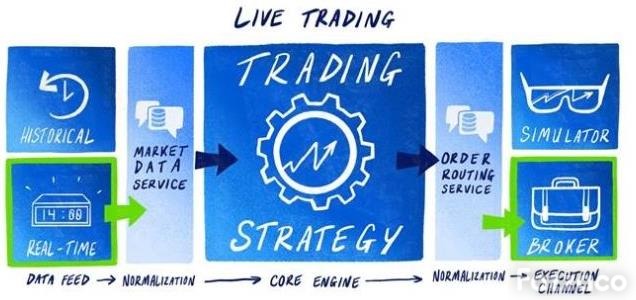
Systemathics’ illustration of market data, strategy logic and execution connections. Source: Systemathics.
Start with the identity of each market event
Tick Capture is the collection layer. Systemathics describes support for simultaneous data sources, multi-venue order-book consolidation and normalized data models. Its reference-data tools include nightly updates, cross-validation between sources and retention of a customer's existing symbol conventions. The platform covers several asset classes, including foreign exchange, equities and futures.
Those functions matter before a strategy starts calculating signals. Two feeds can name the same instrument differently; two instruments can also look similar while representing different contracts or venues. Keeping a familiar internal symbol is useful only if it continues to resolve to the intended instrument. Consolidating books likewise requires preserving enough information to understand where a price originated.
For an FX model, this makes the chosen feed part of the experiment. A record of one liquidity source describes the opportunities visible through that source. Combining additional feeds changes the information set; it does not retrospectively prove that every quoted price was accessible to the trading account. Data normalization and executable access solve different problems.
Replay the sequence, not just the price curve
The Trading Engine processes historical events sequentially and supports tick data and full order books. Systemathics says its simulator models the order workflow, including market impact and exchange rules. That architecture can represent a strategy reacting to an update, submitting an order and receiving a subsequent execution event.
Consider a deliberately simplified example. An ask quote is 100.00 at 10:00:00.000. A signal reaches the strategy at 10:00:00.005, and the ask changes to 100.03 at 10:00:00.010. If the resulting order reaches the venue at 10:00:00.015, assigning a fill at the earlier ask would require an additional explanation. A chart containing both prices cannot, on its own, establish the order's achievable execution price.
The example is hypothetical, not a Systemathics performance test. It illustrates why event ordering, latency assumptions and the fill model must agree. An event-driven design helps enforce the sequence supplied to it; it cannot repair an incorrectly timestamped input or a simulation configured with unrealistically generous fills.
The same distinction applies to look-ahead bias. Sequential delivery can stop a strategy from reading later events through the normal feed. It does not automatically make every research input historically valid. A dataset prepared using information learned later can still contaminate the experiment before the replay begins.
Keep strategy code stable while changing its environment
Systemathics describes a code-invariant design: the strategy's source code can be reused for backtesting, paper trading and live operation, with market-data and execution plug-ins changed around it. Its SDK also supports custom components and integration with third-party libraries.
This reduces one specific source of discrepancy: translating a research model into a separate production implementation. If the trading rule is rewritten, an unexpected result could come from the original idea, the translation or the surrounding infrastructure. Reusing the rule removes one of those moving parts.
It does not make the environments identical. A simulated execution component and a live broker connection receive different feedback. Rejections, partial fills and delayed acknowledgements can alter the strategy's state even when its source code is unchanged. A useful comparison therefore follows individual decisions and order events across environments, rather than comparing only the final profit figure. Code continuity is an engineering advantage; identical trading outcomes are a separate claim.
Execution logic belongs inside the experiment
Smart Orders gives users a choice between broker-provided execution algorithms reached through routing and Systemathics' own customizable library. The company lists VWAP and iceberg algorithms, among others, and states that its smart orders can be backtested. Users can adjust parameters or develop their own execution logic.
This brings implementation into strategy research. A model may decide to buy a quantity, but an execution algorithm determines how that quantity is released into the market. Splitting it into smaller orders changes the timing and exposure of the remaining quantity. Following a volume benchmark introduces a different objective from completing the order as quickly as possible.
Simulation can compare those choices under a consistent scenario. The meaningful result includes how much was filled, when it was filled and what remained outstanding, alongside price-based measures. A favorable average price on a small completed fraction does not establish that the entire investment decision was implemented effectively. Nor does an algorithm's name guarantee the same behavior through every broker connection.
Separate managed data from the trading runtime
Ganymede addresses the data-engineering side as a managed service. Systemathics describes collection, cleaning and normalization spanning tick, intraday and daily observations, reference data, corporate actions and sustainability information. It is distinct from the Trading Engine's role of running strategies and processing their order workflow.
That separation is useful when assigning responsibility. A data service can prepare research inputs; the trading runtime still needs a defined event sequence and execution configuration. For a team adopting the suite, the essential handover is a reproducible chain: the selected instruments and data, the strategy version, the execution assumptions and the resulting order history. Systemathics' product architecture provides components for connecting that chain. Its practical value rests on keeping those connections explicit as a strategy moves from historical research to live operation.
 Subscribe Now