


Takeprofit Tech: Liquidity Bridge, Risk Tools and MetaTrader Plugins for Brokers
Takeprofit Tech supplies technology for FX/CFD broker operations rather than operating as a forex broker. Its public portfolio centers on Takeprofit Bridge, a liquidity aggregation and order-management product, alongside MetaTrader plugins for dealing, leverage, money management, reporting and other workflows. For a broker evaluating this vendor, the central question is how these components would fit an existing platform and liquidity stack, not how many items appear in a product catalogue.
This Fazzaco company introduction draws on the Takeprofit Tech website, its Bridge product page, the MetaTrader plugins catalogue and the Fazzaco company profile, checked on 5 October 2026. Product functions below are attributed to the supplier. Procurement questions are Fazzaco editorial analysis, not a claim that we have tested a production deployment.
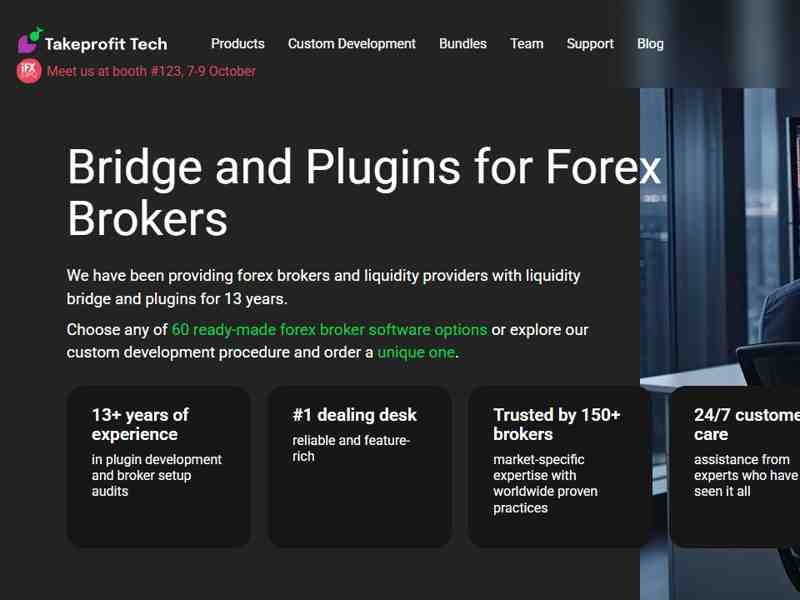
Takeprofit Tech official website, captured 5 October 2026.
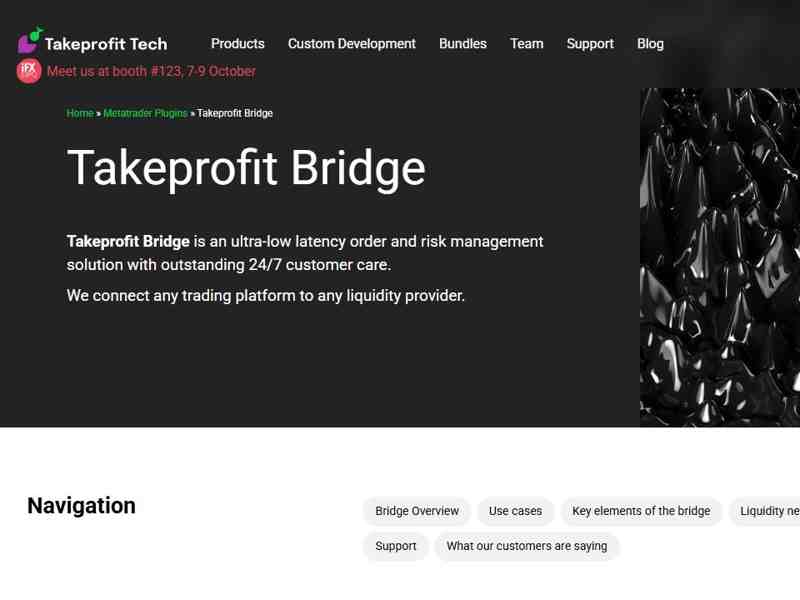
Takeprofit Bridge product page on the official website, captured 5 October 2026.
Where Takeprofit Tech sits in a broker's architecture
The supplier describes its bridge as the connection between trading platforms and liquidity providers. Its current page names MT4, MT5, cTrader, TradeLocker, DXtrade and custom API-connected platforms as potential endpoints. It also describes self-hosting and hosting in Takeprofit's data centers. These are materially different deployment choices: they determine who maintains servers, network links, monitoring, backups and access controls.
A broker should start with an architecture map. Identify the authoritative systems for prices, orders, positions, balances and client statements. Mark every boundary between platform, bridge, liquidity provider, CRM, risk tools and reporting. Then assign an owner to each interface and failure mode. A demonstration that shows a trade executing is useful, but it does not establish how the same system handles reconciliation or a partial outage.
| Layer | Supplier-described capability | Buyer evidence to request |
|---|---|---|
| Takeprofit Bridge | Liquidity aggregation, routing and order management | Supported versions, provider links, rule configuration and test logs |
| Risk panel and exposure controls | Monitoring, alerts and position limits | Role permissions, alert thresholds, audit history and escalation workflow |
| MetaTrader plugins | Dealing, leverage, commission, reporting and account functions | Platform compatibility, license scope, upgrade policy and rollback plan |
| Hosting and support | Vendor-hosted or customer-hosted bridge options | Security responsibility, support hours, recovery commitments and exit rights |
Liquidity aggregation and routing decisions
Takeprofit Bridge's product page describes simple aggregation of best bid and ask quotes and a more advanced, volume-based approach that can route or split orders according to size, instrument and provider capacity. It also describes multiple price channels, symbol mapping, markups and A-book/B-book allocation. These features matter because a broker may need different execution policies for different instruments, client groups and market conditions.
The operational test should follow a quote from its source through the bridge to the client terminal and then follow an order through validation, routing, execution, booking and statement generation. Record identifiers and timestamps at every handoff. Run normal flows and exceptions: a stale quote, a rejected hedge, partial fills, a provider disconnect, a symbol mapping change and a price-channel adjustment. The broker should be able to explain why each client order received its result.
Routing flexibility is not automatically an execution-quality result. The vendor page makes performance and latency claims, but a buyer needs measurements from its own connectivity, instruments and expected message volumes. Ask for sandbox access, raw logs, fill and reject distributions, and a method for repeating the test after upgrades. Regulatory and client-disclosure requirements must be considered for each jurisdiction and operating entity.
Risk panel, exposures and failover
The Bridge page lists monitoring of open positions, balances, net and gross volumes, latency, execution speed and rejections. It describes exposure limits by instrument or liquidity provider, selected-client limits, alerts, scheduled spread adjustments and emergency failover to a backup provider. Those are capabilities to verify within the proposed edition and configuration; they should not be treated as independently proven risk outcomes.
A risk team should specify control tests before signing. Can it identify a rapidly changing net position across client groups? Who may alter a limit, and is there approval or audit evidence? Does an automatic hedge stop when a market is closed or a provider rejects orders? If failover occurs, are price and order states reconciled between primary and backup links? The answer should come from scenario testing and written operating procedures.
Particular care is needed where a rule affects client execution, such as a spread change, delay, markup or minimum holding time. The broker must define the commercial and legal basis for the rule, who is authorized to set it, how it is disclosed where required and how disputes will be investigated. A bridge exposes controls; it does not transfer the broker's responsibility for fair operation to the software vendor.
MetaTrader plugins beyond the bridge
Takeprofit Tech's official catalogue includes Dealing Desk (Ashira), Dynamic Leverage, EasyMAM, PAMM Software, social trading, a broker dashboard, account-history transfer and commission-related tools. This breadth could help a broker consolidate procurement, but each tool serves a separate workflow. The buyer should avoid assuming every item is bundled with the bridge or supported on every platform version.
For dealing and leverage tools, test policy changes against actual account groups and volatile market scenarios. A leverage rule should have a clear trigger, effective time, client communication path and rollback method. For MAM and PAMM, verify allocation logic, fees, statements, investor consent and exception handling. For reporting and commission tools, reconcile outputs with the broker's finance and CRM records before relying on them for payment or client reporting.
MetaTrader server upgrades and plugin releases are an ongoing operational issue. Require a compatibility matrix for MT4/MT5 builds, staging access, release notes and support escalation. Ask which functions run as server-side plugins, which are standalone applications and which require an external database. A feature that works in a demonstration environment can still create maintenance risk if its dependencies are not documented.
Data quality and management reporting
Several products in the catalogue affect the same underlying account and trading data. A dashboard may count trades and execution time, while a commission tool calculates charges and a money-management module allocates results. The brokerage needs consistent definitions across them. Does a partially filled order count as one trade or several? At which timestamp does an account balance become final? How are corrections and canceled operations represented in historical reports? These details determine whether operations, finance and client support can work from the same evidence.
In a pilot, reconcile daily totals between the trading server, bridge, CRM, payment ledger and finance reports. Include open positions, deposits, withdrawals, commissions, adjustments and reversals. Keep a record of unexplained differences and the system responsible for resolving them. If the vendor offers account-history transfer for a migration, verify both completeness and provenance: historical data should remain traceable to its original source, and clients should be able to understand any visible change in their statements.
Change management after launch
Technology selection is not finished at go-live. A broker will add providers, instruments, client groups and new rules. It should test whether a change can be previewed in staging, approved by a second person, scheduled for a specific time, monitored in production and rolled back if needed. The Bridge page states that settings can be applied without a restart. That claim is useful to verify, but instant application also raises a governance question: who is allowed to alter a live pricing or routing rule, and where is the prior setting recorded?
Release management matters for plugins as well. Agree how Takeprofit Tech communicates fixes, platform-version compatibility and breaking changes. Maintain a dependency register, a documented maintenance window and a recovery copy of configuration. A buyer should also ask what happens if a customized component cannot be maintained by the original developer. Exit provisions should cover data export, configuration documentation and a transition period, not only termination of the software license.
How to assess implementation and hosting
The supplier offers both vendor-hosted and self-hosted bridge options according to its product page. A self-hosted deployment may give a broker more direct infrastructure control, while a vendor-hosted deployment changes day-to-day operational duties. Neither model is automatically preferable. Compare network topology, data location, administrative access, monitoring, backup, maintenance windows and incident response under each proposed contract.
Implementation should be staged. First connect a test platform and one liquidity provider; then add client groups, symbol maps and risk rules. Next run representative traffic and exception cases, parallel reconciliation and controlled cutover. Establish acceptance criteria before going live: which reports must match, which failures require rollback and who signs off from dealing, technology, finance and compliance. If existing accounts or order history move between systems, make data mapping a separate workstream.
The official site advertises service timelines and continuous support. Treat those as vendor statements until the exact service level, response channels, severity definitions and exclusions are written into the agreement. Ask for security and resilience documentation relevant to the contracted hosting model, including privileged access, log retention, vulnerability handling, recovery testing and exit-data export.
Commercial comparison and procurement checklist
A complete cost model should include licensing, setup, provider connectivity, servers or hosting, support, plugin upgrades, custom development and the cost of operating parallel systems during migration. The Bridge page invites customers to request a tailored quote; it does not establish a universal price. Compare a multi-year total cost of ownership using the same transaction and growth scenarios for each vendor on the shortlist.
| Decision area | Question for the proposal |
|---|---|
| Scope | Exactly which Bridge functions, plugins and platform versions are licensed? |
| Execution | Can the vendor reproduce the broker's routing rules and exception cases in a test environment? |
| Data | Where are orders, balances, logs and reports stored, and how can they be exported? |
| Operations | Who owns alerting, incidents, upgrades, change approval and disaster recovery? |
| Commercial terms | What are the setup, recurring, support, connectivity and exit costs? |
| Acceptance | What measurable criteria must pass before production cutover? |
Takeprofit Tech is a relevant candidate for brokers seeking a liquidity bridge with configurable routing and risk controls, or a set of MetaTrader operational plugins. The case for selecting it depends on verified compatibility, implementation evidence, the broker's operating model and contract terms. Its published product descriptions provide a starting point for evaluation; they do not establish measured execution quality for a particular brokerage.
Frequently asked questions
Is Takeprofit Tech a forex broker?
Fazzaco lists Takeprofit Tech under bridge, risk-management and MT4/5-plugin categories. This article evaluates it as a technology supplier, not as a brokerage.
Does Takeprofit Bridge work only with MetaTrader?
The supplier's current product page names MT4, MT5, cTrader, TradeLocker, DXtrade and custom API-connected platforms. A buyer should confirm the exact versions and endpoints in its proposal.
Are the plugins included with the bridge?
The public catalogue alone does not establish bundling or license rights. Ask for a component-by-component quotation and support matrix.
What should be tested first?
Start with a quote-to-order-to-statement workflow, then test rejection, partial fill, provider outage, risk-limit breach and reconciliation. Use the broker's own instruments and account groups.
Sources and verification: Takeprofit Tech official website; Takeprofit Bridge product page; MetaTrader plugins catalogue; Fazzaco company profile. Checked 5 October 2026. Supplier claims are attributed; Fazzaco has not independently tested a deployment.
 Subscribe Now