


Top Liquidity Bridges 2026: Behind the Architecture
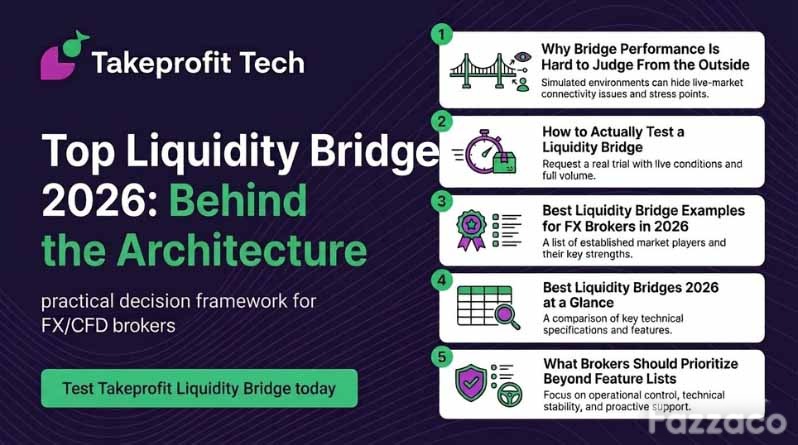
Why Bridge Performance Is Hard to Judge From the Outside
A sales demo runs on a stable connection with light order flow. It doesn't reproduce an LP dropping connection mid-session, a spike in order volume, or a failover between primary and secondary servers — these scenarios depend on real market conditions and live LP infrastructure, not something a vendor can trigger in a sales meeting.
As a result, the properties that matter most under stress — how failover is triggered, how latency holds up as order flow increases, how the system degrades when something goes wrong — are invisible until a broker is already running live volume on the bridge.
That's why the criteria below focus less on advertised specs and more on what tends to separate resilient bridge setups from fragile ones under real conditions
How to Actually Test a Liquidity Bridge
A trial period before commitment is standard practice among liquidity bridge vendors. Takeprofit Tech, for example, provides a two-week trial of its Takeprofit Liquidity Bridge, a solution used by brokers worldwide.
Once installed, this window is a perfect way to check how the bridge behaves.
Here's what to look at during the trial:
● Latency under real order flow. Run the bridge with volumes close to what you actually process, not a handful of test trades. Watch how execution time changes as flow increases, not just the baseline latency at rest.
● Failover behavior. Ask the vendor to trigger a switch from primary to backup server, and time how long the bridge takes to recover and whether any orders are lost or delayed in the process.
● LP disconnection handling. Test what happens when one LP in the aggregation goes offline: does the bridge reroute quotes smoothly, or does pricing gap or freeze?
● Reject rate. Track how many orders are rejected or requoted over the trial period, and under what conditions. This often reveals connectivity or aggregation issues that don't show up in casual testing.
● Support response time. Deliberately raise a technical question or issue during the trial and measure how long it takes to get a substantive reply. This is a preview of what support will look like after go-live.
Best Liquidity Bridge Examples for FX Brokers in 2026
As broker infrastructure becomes more complex in 2026, liquidity bridges are no longer only about connecting trading platforms to liquidity providers. Brokers and liquidity providers increasingly need aggregation technology that supports real-time pricing visibility, routing, execution control, monitoring, and risk management.
The market remains highly specialized, with only a limited number of established infrastructure providers serving FX brokers, liquidity providers, and financial institutions.
Some of the best liquidity bridges used to support liquidity connectivity and aggregation in the FX market are:
● oneZero Liquidity Hub by oneZero, a solution from a long-established market player.
● XCore by PrimeXM, a connectivity infrastructure solution from a well-known provider.
● Takeprofit Bridge by Takeprofit Tech, a recognized liquidity bridge built for robust execution and risk management.
For brokers and liquidity providers, the choice of bridge technology affects pricing quality, execution stability, operational control, and the overall client experience. That is why modern liquidity infrastructure is becoming a key part of how FX businesses scale and compete in 2026.
Best Liquidity Bridges 2026 at a Glance
| | oneZero Liquidity Hub | PrimeXM XCore | Takeprofit Bridge |
Founded | 2009 | 2010 | 2013 |
Risk management features | Advanced | Advanced | Advanced |
Aggregation features | Advanced | Advanced | Advanced |
Execution features | Advanced execution logic | Advanced execution logic | Broad execution capabilities |
LP connectivity | Multiple LPs (exact number not disclosed) | 120+ liquidity sources | 30+ liquidity sources, though any provider can be connected on the broker's request |
What Brokers Should Prioritize Beyond Feature Lists
Feature lists are useful for narrowing down options, but they rarely show how a liquidity bridge will perform in a live brokerage environment. Most established providers offer aggregation, routing, monitoring, reporting, and risk management. The real difference lies in how these functions behave under pressure and how much control the broker has over them.
Brokers should look closely at execution stability during periods of high order flow, the speed and transparency of failover, and the way the bridge handles LP disconnections, rejected orders, and pricing gaps. A technically advanced system is only valuable if its behavior remains predictable when market conditions become unstable.
Operational control is equally important. The bridge should allow teams to adjust routing rules, liquidity settings, markups, exposure limits, and execution logic without depending on the vendor for every change. Clear monitoring and reporting tools also help dealing and risk teams identify problems before they affect clients.
Scalability should be assessed in practical terms. A bridge that performs well for a smaller broker may become harder to manage as trading volume, asset coverage, server count, and the number of liquidity connections increase. Brokers should therefore evaluate not only current requirements, but also how easily the infrastructure can support future growth.
Finally, vendor support should be treated as part of the technology itself. Fast access to experienced technical specialists can make a significant difference during integration, migration, or a live execution issue. In practice, the strongest liquidity bridge is not necessarily the one with the longest feature list, but the one that combines resilient architecture, transparent execution, operational flexibility, and reliable support.
 Subscribe Now

