


TraderEvolution: Multi Asset Trading Platform, APIs and Risk Controls
TraderEvolution is a B2B trading technology provider offering a multi-asset back end, branded trading interfaces and connectivity for brokers and banks. Its central proposition is operational consolidation: exchange-traded instruments and OTC products can be handled within one platform, while the broker chooses its client interfaces, infrastructure and counterparties. For a brokerage expanding beyond forex and CFDs, that makes the discussion about account architecture, product lifecycles and control of data as much as charting or order entry.
The Fazzaco TraderEvolution company profile classifies the business as a Forex Trading Software Provider. TraderEvolution's own website identifies it as a B2B infrastructure company based in Dublin. This profile examines the published platform architecture and its implications for technology procurement; it does not treat the software provider as a broker offering trading accounts to retail clients.
Where TraderEvolution fits in a brokerage technology stack
TraderEvolution describes a single back-end core covering order management, risk, market data, positions, accounts and back-office administration. Symbol mapping, commission processing and white-label functions sit alongside those components. The front-end layer is separate: brokers can use the vendor's web and mobile interfaces, integrate TradingView, or build an interface through the Client API.
This is a broader scope than adding an isolated trading terminal to an existing stack. A buyer should map which system remains authoritative for each record: customer identity, trading-account balances, orders, settlements and reporting. A CRM may continue to own onboarding and relationship management while the trading platform owns execution records. Defining that division early helps prevent two systems from presenting conflicting balances or account states during reconciliation.
The vendor positions its connectivity as liquidity-neutral. That is relevant to brokers maintaining several execution relationships, but a technology connector and a commercial counterparty relationship are separate deliverables. A deployment plan should identify the exact venues, instruments, permissions and data feeds the brokerage intends to activate.
Multi-asset support means managing different product lifecycles
The official product material covers equities and ETFs, listed options, futures, forex and CFDs, crypto instruments and fixed income. More significant than the asset list is the distinction between the events those products create. A cash equity can generate a dividend or stock split; a futures contract expires; an OTC CFD follows the broker's contract specification and financing treatment. These should not be reduced to different symbols with otherwise identical processing.
TraderEvolution states that the platform supports corporate actions including dividends, splits, spin-offs and delistings, with corresponding position and cash adjustments. It also describes per-instrument netting: an account can use a hedge model for one instrument and a net position model for another. The multi-account architecture allows a single client login to access accounts with different instruments, spreads and risk settings.
For implementation teams, the useful demonstration is an end-to-end lifecycle. Follow a trade from instrument configuration through order acceptance, execution, position accounting and a subsequent corporate action or expiry. Check the records shown to the client against the back-office ledger and downstream reports. This tests whether the proposed configuration supports the intended business model, rather than simply whether an instrument can appear in a watchlist.
Deployment and operational ownership
According to the core platform page, TraderEvolution is deployed in the broker's own infrastructure rather than a shared vendor-hosted environment. It lists dedicated servers, virtual machines and public or private cloud as deployment choices. The described environment structure includes user acceptance testing, acceptance, production and disaster recovery.
The B2B significance is control over the operating environment and access to trading data. It also makes the division of operational responsibilities an essential contract topic. Infrastructure provisioning, monitoring, backups, incident response, version upgrades and recovery exercises need named owners. A broker choosing cloud deployment should distinguish the software licence from cloud capacity, connectivity and ongoing operations.
The website describes clustered deployment and horizontal scaling. Those architectural statements should be converted into a workload-specific acceptance test. Relevant measures include concurrent sessions, peak order events, the active instrument universe and the number of downstream consumers. Recovery objectives and failover behaviour should be agreed for the actual environment; this profile does not present the vendor's architecture as an independently measured uptime or latency result.
Client interfaces and the five TradingView integration levels
TraderEvolution offers a web platform with progressive web app functionality and native mobile apps. Its website describes the native apps as branded products published under the broker's developer accounts, with active-trading and simplified investing interfaces. The Client API provides another route for a brokerage with an existing application or a differentiated user experience.
Its TradingView page separates five integration levels: broker integration on tradingview.com, embedded charting, the complete TradingView trading interface, embedded widgets and native webhooks. These serve different purposes. Charting improves an interface already controlled by the broker; broker integration allows clients to connect from TradingView; webhook execution connects alerts to order processing. They should be listed separately in a procurement specification.
The published webhook flow sends an alert and order parameters to the TraderEvolution back end, where the order goes through the execution and risk pipeline. Before enabling that workflow for customers, a broker should test symbol mapping, quantity interpretation, authentication, duplicate requests and rejected orders. A chart alert is an instruction source, not evidence that a trade has executed. The customer interface and support team need a reliable way to distinguish an alert, an accepted order and a fill.
Risk controls and the dealer workflow
The risk-management page describes server-side pre-trade checks for available margin, position limits, instrument restrictions and order size. Configuration can operate at account, group, instrument and asset-class level. Reusable Risk Plans group margin rules, trading modes and loss limits so different customer segments can use different policies.
TraderEvolution also describes warning thresholds before stop-out, configurable liquidation rules and a separate Dealer Terminal for monitoring positions, pending orders and margin utilisation. The terminal can support trading on behalf of clients where permitted. For a brokerage, the practical value lies in connecting policy definition, live monitoring and controlled intervention within an operational process.
A useful acceptance exercise includes both normal and stressed conditions. Test a rejected oversized order, a margin warning, a stop-out sequence and a restricted instrument. Verify which operator can change the relevant parameter and which records capture the change. For a prop programme, the documented daily-loss and drawdown controls should be evaluated against the exact programme definitions, including the reset time and treatment of open positions. Software configuration does not itself establish regulatory compliance.
APIs, event distribution and reporting data
The platform publishes several distinct integration paths. The BackOffice REST API addresses administration, while the Client API covers market data, orders and account-event subscriptions. FIX 4.4 connectivity includes DropCopy support. Kafka streaming, server-side webhooks and a database replica provide additional routes for distributing operational data and supporting analytics.
These interfaces should be assigned to specific jobs. A CRM may need administrative account operations; an execution-reconciliation service may need trade copies; a reporting warehouse may require historical records and a continuous event stream. The existence of several interfaces does not remove the need for consistent identifiers, timestamps and recovery procedures across those consumers.
During integration testing, interrupt a downstream connection and verify how missing events are identified and reconciled after recovery. Check that the same order and execution can be traced across the client interface, back office and reporting destination. This is particularly important when one customer holds several trading accounts or when an instrument is represented differently by an external venue.
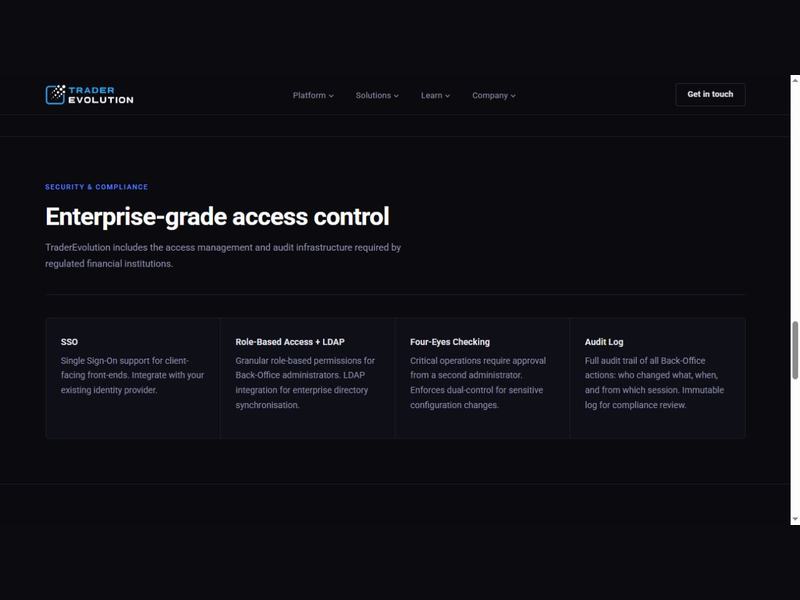
Source: TraderEvolution core platform page, captured 16 October 2026. The screenshot shows the vendor's published access-control features.
Access governance for administrators and automated clients
TraderEvolution's core platform page lists single sign-on, role-based back-office permissions, LDAP integration, four-eyes approval and audit logs. Together, these are relevant to separating daily support activity from sensitive configuration changes. Buyers should demonstrate the roles they intend to operate, rather than only testing with an unrestricted administrator.
The homepage also presents an MCP server built on the Client API and deployed within the broker's infrastructure for AI-agent access. This adds another potential client channel to the architecture. Its operational assessment should start with permitted actions, credential scope and whether a given connection is allowed to submit orders. A useful pilot can begin with market-data and account-information queries before enabling any execution capability.
Automation should be evaluated against the same account permissions and risk rules as other interfaces. The procurement question is not simply whether an AI client can connect, but how the brokerage supervises its access, records its actions and revokes that access when necessary.
A practical acceptance plan for brokers and banks
The following tests translate the published feature set into a focused demonstration. They are editorial procurement recommendations, not claims that Fazzaco has independently tested a production deployment.
| Workstream | Demonstration | Evidence to retain |
|---|---|---|
| Instrument lifecycle | Execute a trade and process an applicable expiry or corporate action. | Matching position, cash and report records. |
| Routing and risk | Route an eligible order and reject a rule-breaking order. | Counterparty selection and rejection reason. |
| Client channels | Trace a web or webhook order through to execution. | Consistent identifiers and customer-visible status. |
| Data integration | Disconnect and recover a downstream consumer. | Reconciliation of missing or repeated events. |
| Governance | Request and approve a sensitive configuration change. | Role permissions, second approval and audit record. |
| Operations | Exercise the agreed recovery process. | Measured recovery results and assigned responsibilities. |
Commercial evaluation should then match the technical scope: selected interfaces, environments, integrations, market-data arrangements, implementation assistance and support responsibilities. The reviewed pages do not establish a universal price for this configuration. A scoped proposal is more informative than assuming every described capability, third-party service and operating cost is included in one standard package.
Which organisations should examine TraderEvolution?
TraderEvolution is relevant to brokers and banks seeking a unified trading back end while retaining choices over client interfaces and infrastructure. It is particularly worth examining when expansion into additional asset classes creates new settlement, corporate-action, risk and reporting requirements that an interface-only change would not address.
The strongest evaluation follows a representative customer account through its entire operating day: login, order entry, execution, risk events, position changes, reporting and support intervention. That connects the product's published capabilities to the brokerage's actual service model and provides a concrete basis for comparing implementation proposals.
Sources, checked 16 October 2026: TraderEvolution platform overview, core back-end architecture, TradingView integration, and risk-management system. Product capabilities are attributed to the vendor's published material; evaluation scenarios are Fazzaco editorial analysis.
 Subscribe Now

