


TraderMade: Live FX Quotes, Historical Rates and Streaming Recovery
TraderMade supplies market data for trading platforms, payment applications and corporate finance systems. Its delivery options include REST, WebSocket and FIX, with live and historical FX data alongside other instruments. For a business integrating that feed, the important distinction is what each observation represents: a current indication, a stored historical bar or a cached quote received after reconnecting.
These observations can all be valid and still answer different questions. An exposure screen needs to show when a price was observed; a valuation job needs a reproducible date and rate convention. A green connection indicator, by itself, answers neither question.
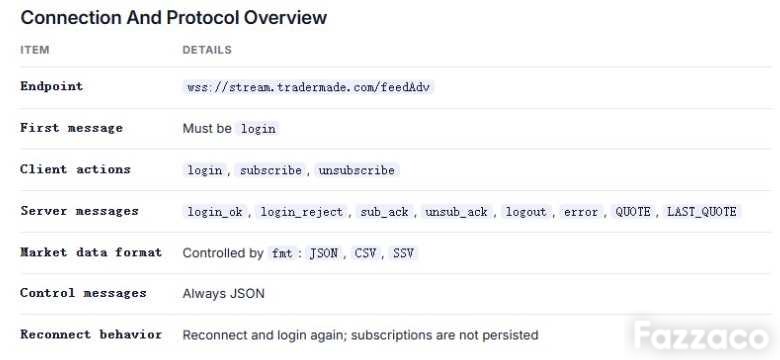
TraderMade WebSocket v2 protocol overview. Image: TraderMade.
A fresh response is not the same as a fresh quote
TraderMade’s REST documentation describes bid, ask and mid fields for live quotes. It also offers a per_quote_ts option that adds a timestamp to each quote instead of relying on one timestamp for the response. Historical requests return open, high, low and close values for a specified date, while separate endpoints provide hourly and minute bars.
Consider a hypothetical dashboard requesting two currency pairs together. The application can receive both in one response without establishing that the underlying observations were made at exactly the same instant. Keeping a quote’s timestamp alongside its value makes that distinction visible. A receipt time recorded by the application remains useful for diagnosing transport delays, but it should not silently replace the market-data timestamp.
The distinction also matters when rebuilding a report. Calling a live endpoint tomorrow cannot recreate yesterday’s valuation. The stored record should identify the pair, date or interval, selected field and any conversion applied by the business. A chart close, a midpoint and a customer-facing conversion rate are different inputs even when the currency labels match.
What returns after a streaming connection breaks?
TraderMade’s WebSocket v2 protocol separates login from subscription. A successful login reports account capabilities, including the subscription limit and whether CFD or ladder data is enabled. A subscription acknowledgement identifies accepted, denied and invalid symbols; some symbols in a batch can succeed while others do not.
The documentation says subscriptions do not persist across a reconnect. An application must log in again and restore them. An optional send_last request provides a cached LAST_QUOTE on subscription. That is useful for populating a screen immediately, but a cached value is not evidence that a new tick has just occurred.
This creates a practical sequence for a broker’s price display. After a connection loss, the display can retain the last value while identifying its age. Once access is restored, it can compare the requested symbols with those accepted and show which instruments are still unavailable. Only the arrival of subsequent data establishes that a particular stream is updating. Treating login success as recovery of every instrument would hide partial failures.
The same logic helps distinguish a permissions problem from a market-data interruption. Repeatedly reconnecting will not grant a capability that the account lacks. The denied-symbol response gives the application a more specific explanation than a generic “feed unavailable” banner.
Historical rates belong to a defined business process
TraderMade’s ERP and treasury offering describes daily and intraday rates for revaluation, with delivery into systems such as SAP and spreadsheet workflows. Its published SAP route fetches rates over REST and passes them into Market Rates Management. The customer still determines rate types, rounding and posting rules.
For a group with multiple entities, that division of responsibility is consequential. If one entity stores EURUSD and another stores its inverse, consolidation needs a consistent convention before it can compare the numbers. If a valuation is tied to a local cut-off, the job also needs an explicit time-zone rule. Supplying the feed does not, on its own, settle those accounting choices.
TraderMade’s terms describe its data as indicative rates. A usable data connection therefore should not be presented as a promise to execute a trade at the displayed price. Its streaming licence terms also describe a single connection per licence, with additional connections requiring separate arrangements. A deployment using multiple active instances needs to resolve that entitlement before treating redundancy as merely an engineering decision.
TraderMade fits the data-supply layer of these workflows. Its practical value comes from matching an observation to its purpose: live quotes for a current view, historical records for a dated calculation, and explicit subscription state for a streaming application that can explain what it is actually receiving.
 Subscribe Now

