


Trustly Pay by Bank for Brokers: Deposits, Payouts and Integration Checks
Trustly is a Pay by Bank provider whose public product range spans online payments, bank-account deposits, payouts, recurring payments and data services. For a broker evaluating payment infrastructure, the relevant question is not whether a provider advertises fast transfers. It is whether a specific legal entity, merchant model, customer geography and transaction flow can be supported under a written agreement. This Fazzaco profile separates Trustly's published capabilities from the operational checks a brokerage should make before integration.
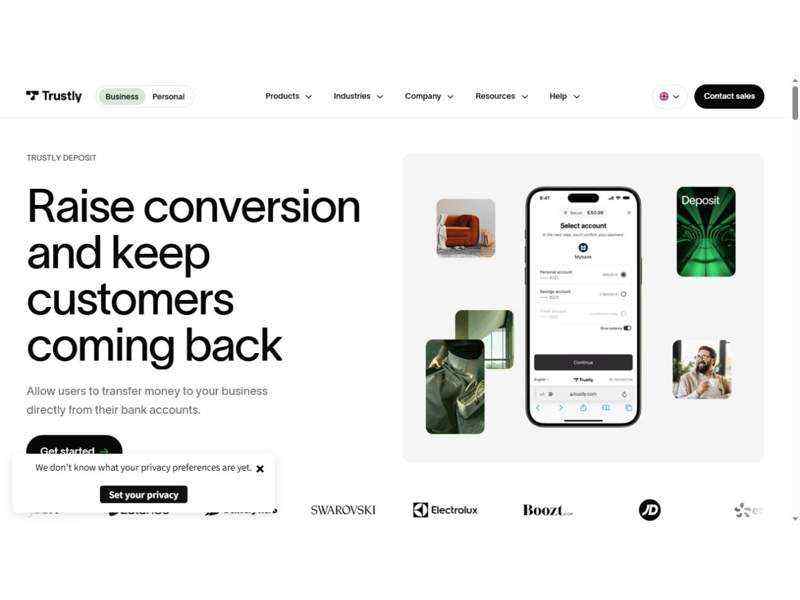
Official Trustly Deposit page; product availability depends on contract and market.
Where Trustly fits in a broker payment stack
A brokerage cashier connects the trading account to external payment methods, a client ledger, risk controls and reconciliation. Trustly's bank-account rails could be relevant at the collection and disbursement edges of that stack. Its official site describes payment, deposit and payout products, as well as data services and recurring payments. These are distinct capabilities: an attractive deposit flow does not establish that the same merchant can use payouts in every target market.
Trustly is listed in Fazzaco's Forex Payment Provider directory. That directory classification helps buyers discover vendors; it does not verify acceptance of any particular forex, CFD or prop-trading business. The first commercial diligence item is therefore written confirmation of supported merchant activity, contracting entity, jurisdictions and use cases.
Deposit flow: from bank authorization to ledger credit
On its Deposit product page, Trustly presents direct bank-account funding for business cashiers. The customer selects a bank and account, authorizes through the bank or electronic identity flow, and returns to the merchant experience. Trustly describes reduced manual entry for returning users. For a brokerage, the real design task begins after that customer-facing step: the cashier must map the provider's transaction reference to the client, trading account and internal ledger.
A deposit can move through several states. An authorization or payment initiation event is not necessarily the same as irrevocable receipt or merchant settlement. Product teams should document the exact event that makes funds available for trading, the event that confirms final settlement, and the method for reversing a provisional credit. A test plan should include expired bank sessions, customer cancellation, duplicate callbacks, partial failures, account-name mismatches, and a successful payment whose notification arrives late.
The decision to credit immediately or wait for a stronger settlement signal is a broker risk decision. It should be tied to provider documentation, limits, safeguarding arrangements and the broker's own policies. Neither Trustly's published product page nor this article establishes a universal crediting rule.
Payouts require separate commercial and technical checks
Trustly's Payout product page describes bank-account disbursements, including standalone, bulk and scheduled options, with routing assistance from its Azura technology. The page discusses European coverage and a single API integration. Those statements should be read in their stated regional context, not extended automatically to every customer country, currency or brokerage entity.
For a trading business, the withdrawal workflow should bind the requesting client, verified bank-account owner, available balance, approval status and payout instruction. Buyers should ask whether a payout may return to the same account used for deposit, how beneficiary changes are controlled, what happens when an account is closed, and how failed or returned payouts are represented. A fast user notification is not a substitute for a reconciled completion state. The customer-facing promise should reflect the slowest relevant approval, bank and settlement step.
Integration architecture and control points
Trustly's public site points merchants toward direct API integration as well as partner or payment-service-provider routes. A broker should compare these models against its cashier and back-office architecture. Direct integration may provide more control over the user journey and transaction data, but it also creates responsibility for lifecycle mapping, idempotent requests, webhook validation, retries, incident handling and version upgrades. An intermediary may simplify implementation while changing data access, commercial terms and support ownership.
| Control | What to verify before launch |
|---|---|
| Merchant scope | Written acceptance of the exact broker activity, brands, entities and countries |
| Deposit states | Which events mean initiated, authorized, received, settled, failed or reversed |
| Payout states | Approval, submission, bank acceptance, completion, return and cancellation semantics |
| Identity linkage | Bank-account ownership data, consent, retention and mismatch handling |
| Reconciliation | Stable IDs, statement exports, fees, currency conversion and cut-off timing |
| Resilience | Duplicate callback handling, retry policy, bank outages and fallback methods |
This table is a Fazzaco procurement checklist, not a representation that every listed control is included in a Trustly contract. Buyers should obtain the current API specification, sandbox access and settlement schedule for the markets they actually serve.
Customer experience: more than a checkout conversion claim
Bank-account payments can remove card-detail entry and return the user to the merchant after bank authentication. In a brokerage cashier, however, a smooth front end also depends on bank availability, identity matching, device switching, clear transaction status and accessible support. A user who sees “payment successful” while the trading ledger remains uncredited may regard the journey as failed. The same applies when a withdrawal is approved internally but its bank payout is still pending.
Trustly publishes performance figures on its marketing pages. Fazzaco has not independently verified the methodology, sample or relevance of those figures to forex brokers, so they are not used as evidence here. A broker should instead pilot its own approval, completion, settlement and support metrics by market and payment method. The comparison should count abandoned authentications and returned payouts, not just transactions that reach a confirmation screen.
Data services and recurring payments: adjacent, not automatic
Trustly also advertises data and recurring-payment products on its official site. Bank-account data may help with onboarding or ownership checks when the appropriate product, permissions and lawful basis are in place. A broker should specify which data fields are actually returned, whether they can be used for its intended verification purpose, how consent is captured, and how long the data may be retained. A separate provider or internal control may still be needed for full KYC and AML obligations.
Recurring payments should likewise be assessed separately from one-off deposits. Buyers need to understand mandate creation, variable amounts, customer cancellation, failed collections, notifications and regional availability. A product shown in the global portfolio is not proof that it can be switched on for a given broker account.
Commercial diligence for cross-border brokers
Payment coverage is often described by country, but a broker purchases a specific contractual and operational service. The proposal should identify the contracting Trustly entity or partner, supported client residency, sending and receiving banks, currencies, transaction limits, settlement accounts, reserves, fees and payout route. Ask whether the merchant category is permitted under each relevant entity's policy. If the broker operates multiple brands or regulated entities, obtain an answer for each one.
Compare the full cost of a completed deposit and withdrawal cycle rather than a headline transaction fee. Include rejected payments, returns, foreign exchange, support effort, funding timing and the cost of a fallback method. Contractual service levels should distinguish platform availability from bank availability and specify how incidents are escalated. A proof of concept is useful only if it exercises real exception paths and produces reports that finance and operations can reconcile independently.
A practical evaluation sequence
Confirm merchant eligibility, jurisdictions, legal entities and proposed payment flows in writing.
Map deposit and payout states into the cashier, risk engine and client ledger.
Review API, webhook, data-protection and incident documentation with engineering and compliance teams.
Run sandbox tests for success, cancellation, timeout, duplicate events, bank outage and returned payout.
Pilot limited live traffic and measure authorization, completion, settlement, exceptions and support tickets by market.
Approve rollout only after finance can reconcile transactions and customer support can explain every visible status.
Frequently asked questions
Is Trustly a forex broker?
No. Trustly presents itself as a Pay by Bank payment provider. Fazzaco lists it under payment providers, not under brokers.
Does Trustly guarantee instant deposits and withdrawals for brokers?
No universal guarantee follows from the public product pages. Timing depends on the specific flow, bank, market, approval process and contract. Buyers should obtain written event definitions and test the full cycle.
Can every brokerage use Trustly?
Public marketing material does not establish acceptance for every trading business. Confirm the precise merchant model, entity and jurisdictions directly with Trustly or its authorized partner before planning a launch.
What should a broker ask for first?
Start with written eligibility, a market-and-bank coverage matrix, settlement and payout terms, current integration documentation, and a sample reconciliation file.
Editorial note: This Fazzaco company introduction is based on Trustly's public product pages reviewed on 6 October 2026 and the Fazzaco directory record. Product availability and contractual terms must be verified for each merchant. No independent performance test or commercial endorsement is implied.
 Subscribe Now