


Vietnam's Export Engine Is Firing, But Traders Shouldn't Ignore the Warning Lights
Summary: Vietnam's exports are booming in 2025, but hidden risks in certification delays and red tape could derail key gains in fruit, seafood, and wood sectors.
Vietnam's 2025 export surge is nothing short of remarkable. Growth in fruits, seafood and wood sectors has propelled the country to new prominence - but under the surface, regulatory and logistical friction threatens to blunt the gains. We at EBC Financial Group believe traders must look beyond headline figures to understand the risks beneath.
David Barrett, CEO of EBC Financial Group (UK) Ltd, succinctly described the current dynamic. "Vietnam is clearly winning in terms of trade visibility and sectoral growth," he said. "But traders must watch both the growth story and the friction points. The country's booming exports are becoming increasingly segmented - what's thriving abroad may still stumble at the border."
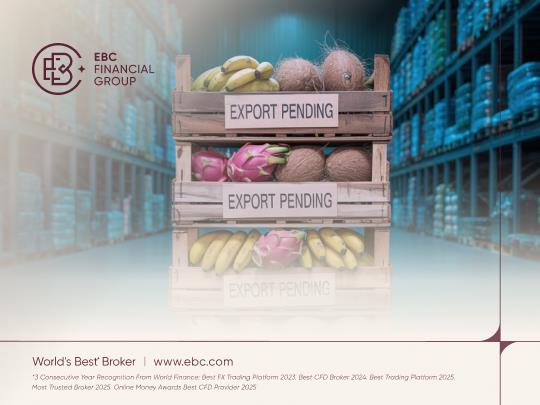
Fruits, Seafood and Wood: Vietnam's Export Winners
The country's agricultural sector continues to gather pace, especially across high-value exports. In the first seven months of 2025, fruit and vegetable exports were worth over USD3.8 billion, with durian, coconut, dragon fruit and lychees selling strongly abroad. In particular, durian exports reached USD3.3 billion in 2024 and more than USD360 million in June of this year. Improved cross-border quality assurance and direct rail links to China are credited for anchoring Vietnam's position as a major supplier in this sphere. Coconut prices have also risen sharply - from USD1.21 per kilogram in 2022 to USD7.26 in 2025 - as demand from Korea and the Middle East spikes for plant-based beverage ingredients.
The momentum in seafood, especially shrimp, has been equally impressive. Between January and June 2025, shrimp exports to China including Hong Kong totalled nearly USD595 million - an increase of more than 80% year-on-year. This surge marks the first instance where China surpassed the United States as Vietnam's largest buyer of shrimp.
The wood sector, often operating out of the limelight, remains a quietly powerful contributor to trade totals. In the first half of 2025, wood exports reached USD8.21 billion - a year-on-year increase of 8.9%. The US accounted for 55.6% of this volume, followed by Japan and China. In a nod to ESG-sensitive markets, many exporters now hold FSC certification to access sustainability-focused buyers across furniture, MDF boards and other value-added goods.
Regulatory Bottlenecks Threaten Gains
Despite this strong export momentum, growing red tape is increasingly visible - and consequential. Delays in certification have disrupted shipments of time-sensitive goods. For example, dragon fruit exporters have lost significant volumes due to procedural bottlenecks. More than 100 tonnes of GlobalGAP-certified dragon fruit spoiled after 20 days in storage while awaiting clearance, and an additional 50–70 tonnes remain idle in cold warehouses.
One notable incident involved Son Tra Co in Lam Đồng, which reportedly had to discard 40 tonnes of fruit. Another 50 tonnes were ultimately sold at VND1,000–2,000 per kilogram - roughly one-tenth of the usual VND20,000/kg EU export rate - underscoring the financial pain of delays. This problem reflects what many industry participants describe as a "last-mile bottleneck" - a critical gap between production readiness and actual export clearance.
The EU Tightens the Rules
These issues are compounded by new regulations in key markets. The EU is tightening rules around origin certification, pesticide residues and cold chain documentation. In response, Vietnamese authorities have issued new directives to prevent trans-shipment violations and improve traceability. Traders should expect longer lead times, inconsistent customs processing and potential price suppression if compliance isn't up to standard. In fast-moving agri-markets, even modest delays can turn profitable trades into costly losses.
The Story Behind the Numbers
For traders, these dynamics present both opportunities and challenges. Vietnam's export data captures two narratives. On the one hand, there is the undeniable strength of durian, coconut, shrimp and FSC-certified lumber; on the other, increasing operational risks tied to red tape and certification inefficiencies. David Barrett's observation about segmentation in the export boom highlights the crucial need to monitor not only volume but also export infrastructure.
This becomes especially relevant in markets such as soft commodities and agricultural futures. Agility matters. Traders should track customs clearance timelines, regulatory announcements, transport and cold-chain lead times, and price shifts triggered by bottlenecks. Transport disruptions - particularly during peak holiday seasons - or compliance backlogs can swiftly undercut margins.
A Trade Powerhouse with Fragile Points
Vietnam's export story is one of strength - but also of vulnerability. The country's access to premium demand markets via quality certification or ESG credentials is an asset; yet, the slow-moving parts of the regulatory ecosystem risk undermining that edge. The balance between reform and friction will dictate how trade resilience evolves through 2025.
We at EBC remain focused on analysing this evolving landscape. Our recommendation to traders is simple: move with insight, not assumption. Trade strategies that recognise regulatory pace, logistical friction and certification investment are better positioned for success. The lesson is clear - ambition is only valuable if backed by delivery.
Disclaimer: This article reflects the observations of EBC Financial Group and all its global entities. It is not financial or investment advice. Trading in commodities and foreign exchange (FX) involves significant risk of loss, potentially exceeding your initial investment. Consult a qualified financial advisor before making any trading or investment decisions, as EBC Financial Group and its entities are not liable for any damages arising from reliance on this information.
 Subscribe Now