


VoiceSpin: AI Dialer, Contact Center and CRM Integration for Brokers
VoiceSpin provides AI contact center software that brings outbound calling, customer messaging and conversation analysis into sales and support workflows. For a brokerage, its relevance is the communication layer around the client relationship: reaching an interested prospect, routing an inbound question, recording the outcome and making the next interaction visible to the team. Its AI auto dialer, voice agents and CRM integrations address different parts of that process.
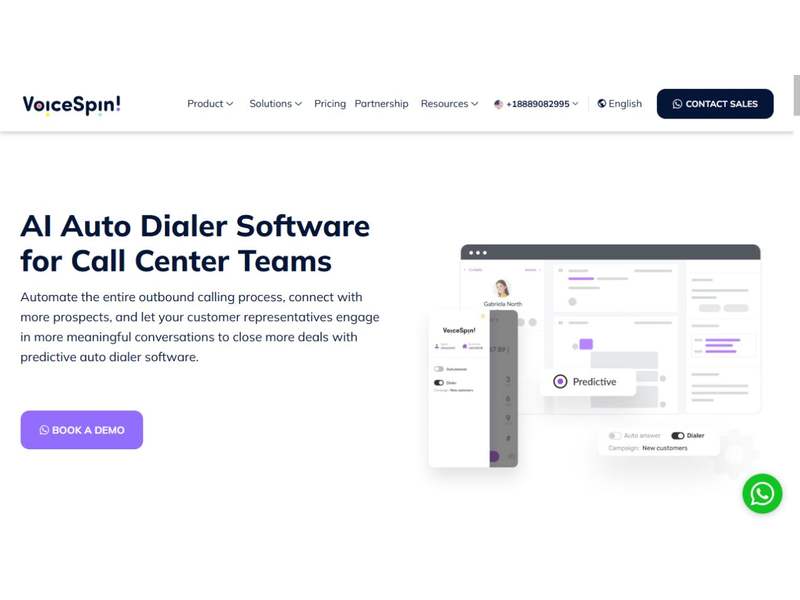
VoiceSpin AI Auto Dialer. Image: VoiceSpin official website.
Where VoiceSpin fits in a brokerage operation
A brokerage can have a trading platform, a client portal and a CRM yet still handle conversations across disconnected telephone and messaging tools. An account manager may call from one interface, record a note in another and ask support to reconstruct the history when the client gets back in touch. A contact center platform connects those activities around the people managing the relationship.
VoiceSpin presents its product range around sales and customer support. The official website describes AI voice bots, chatbots, an AI auto dialer, omnichannel messaging and speech analysis. These are separate capabilities with different operational uses. An outbound sales desk may begin with the dialer and CRM logging, while a service operation may place more emphasis on incoming enquiries, routing and access to conversation history.
For brokers, useful applications include following up on requested demonstrations or account enquiries, scheduling a conversation with the appropriate team and answering routine service questions. The implementation should connect each interaction to the correct customer record and responsible employee. That is what turns a communications tool into a usable part of daily operations.
AI auto dialing: from a lead list to a live conversation
VoiceSpin's AI Auto Dialer is designed to automate outbound calling and reduce the manual work involved in moving through a contact list. Its product page describes predictive dialing that considers agent availability, as well as filtering of unanswered calls, busy lines, disconnected numbers and answering machines. The intended workflow is to bring an available representative into a live conversation instead of asking that representative to initiate every attempt manually.
The vendor also describes AI and machine learning that score and prioritize leads and match them with agents based on the predicted likelihood of a sale. For a brokerage, this is best understood as a routing and prioritization capability. Its practical value depends on the quality of the records entering the system and the suitability of the assignment rules for the business. A prospective institutional customer and a routine service enquiry need different handling, even when both originate from the same website.
The operational design starts before dialing. Lists need meaningful ownership, language and campaign information, and outcomes need consistent definitions. Teams can distinguish a completed conversation from a callback request, an incorrect number or a request to stop further contact. Clear dispositions make reporting useful and give the next employee a reliable starting point.
Caller identity, voicemail and contact preferences
The dialer page lists local caller ID, prerecorded voicemail drop, number reputation monitoring and do-not-call or do-not-disturb list filtering. Together, these features cover several details that otherwise become repetitive work for a calling team. A voicemail drop can standardize a short message, while suppression lists help keep excluded records out of a campaign.
These controls work best when they follow an agreed communication policy. A brokerage should know which team owns a number, what the recipient sees, how a callback is handled and how a change in contact preference reaches every relevant system. A request recorded in the CRM needs to affect later calling activity; keeping the information in a note that another campaign never reads is not a complete workflow.
Local caller identity also needs to remain recognizable and consistent with the business. The purpose of a regional number is to make a legitimate conversation easier to return and manage. A useful deployment test is to call back after an outbound attempt and confirm that the customer reaches an appropriate service route with enough context to continue the discussion.
CRM integration keeps activity connected to the client record
VoiceSpin states that calling activity can be logged and synchronized with a CRM, and its dialer page displays integrations including Salesforce, HubSpot, Zoho, Pipedrive and Zendesk. This is relevant to teams that already organize commercial and service activity in one of those environments. The integration discussion should focus on the specific fields and events used by the brokerage, rather than treating the presence of a CRM logo as the whole implementation.
The most useful record is one that answers simple operational questions: who called, which customer was reached, what happened and who is responsible for the next step. Campaign identifiers, timestamps, dispositions and callback commitments can give managers a coherent picture of activity. Where recordings or transcripts are involved, access and retention also need an explicit place in the workflow.
Brokerages using a specialist industry CRM can map their requirements against the available integration route. Contact matching deserves particular attention when one person has several accounts or when multiple employees share responsibility for a corporate relationship. A pilot should establish which system owns the contact data, how duplicate records are handled and what happens when an update does not synchronize immediately.
AI voice agents and digital messaging
VoiceSpin's broader offering includes AI voice agents for inbound and outbound conversations. The company describes use cases such as answering routine questions, qualifying enquiries, arranging appointments and transferring a conversation to a live representative with context. It also describes connections to backend systems and calendars, allowing the interaction to use information beyond a fixed greeting.
In a brokerage setting, a focused initial use case could be arranging a callback or directing a product enquiry to the right department. A clear boundary between general service information and account-specific action makes the design easier to manage. The value of the handoff is particularly important: a customer should not need to repeat the entire enquiry after reaching an employee.
The website also presents AI chatbots and omnichannel messaging. These extend the communication model beyond telephone calls and help teams consider how a digital enquiry becomes an assisted conversation. A customer may start in a messaging channel and later need a call. Consistent ownership and an accessible history help the receiving team understand what has already been discussed.
Automation is therefore most useful when the next step is designed as carefully as the opening exchange. The team needs an escalation destination, an agreed response to an unrecognized request and a way to review unresolved conversations. Those arrangements determine whether an automated interaction becomes a completed service journey.
Conversation analysis and supervisor workflows
The AI dialer page includes call recording and monitoring, reporting and analytics, and integration with VoiceSpin's AI Speech Analyzer. The vendor describes keyword spotting and real-time alerts as ways to help supervisors identify relevant moments in conversations. Its wider product description positions speech analysis around quality assurance, team performance and compliance-related review.
For brokerage operations, a useful review program can look at whether a representative understood the enquiry, gave an accurate explanation and recorded a clear follow-up. Supervisors can use selected conversations for coaching, while campaign reporting can show where calls are producing useful discussions and where customers repeatedly request a different form of support.
Metrics should reflect the job being performed. A sales team may track qualified follow-ups and completed appointments, while a support team may focus on resolution and successful transfers. Call volume and talk time provide context, but a meaningful operating picture also includes outcomes. The same reporting framework should distinguish a genuinely completed interaction from one that simply ended.
A practical rollout sequence
A controlled rollout can begin with one team, one contact segment and a small set of outcomes. That gives the brokerage a manageable way to test dialing, caller identity, callbacks, CRM synchronization and supervisor access before expanding the scope. It also creates a clear baseline for judging whether the new workflow reduces administrative effort.
| Workstream | What the team should establish |
|---|---|
| Contact preparation | Ownership, language, campaign eligibility and suppression rules |
| Calling workflow | Agent availability, dispositions, voicemail and callback routing |
| CRM connection | Contact matching, activity fields, update ownership and exception handling |
| Service automation | Approved answers, escalation destinations and handoff context |
| Supervision | Recording access, review criteria and outcome-based reporting |
The pilot should include ordinary exceptions: a duplicate contact, a missed callback, an unavailable representative and an enquiry that needs another department. Testing these situations reveals how the team will actually work together. After the initial process is stable, the brokerage can extend automation to additional campaigns, languages or communication channels without redesigning the entire operation at once.
VoiceSpin as a connected customer communication layer
VoiceSpin brings together capabilities that are often evaluated separately: outbound dialing, AI-assisted conversations, CRM activity capture and supervisor review. For brokers, the strongest evaluation starts with a real customer journey and follows it from first contact through resolution or an agreed next step.
The platform's role becomes clearest when each module supports that journey. The dialer organizes outreach, the CRM preserves responsibility and history, messaging provides another route into the team, and conversation analysis supports coaching and review. A deployment built around those connections gives a brokerage a more coherent way to manage customer communication as its sales and support operations grow.
 Subscribe Now