


Voiso Contact Center, CRM Integrations and AI Speech Analytics
Voiso provides cloud contact center software that brings voice calls, messaging, workflow automation and conversation analysis into one operational environment. For forex brokers and fintech businesses, its role is to connect client-facing teams with the information and tools they need to handle enquiries, follow up on requests and maintain a usable communication history. Its fintech offering combines a browser-based softphone, predictive dialing, messaging channels, CRM integrations and AI Speech Analytics.
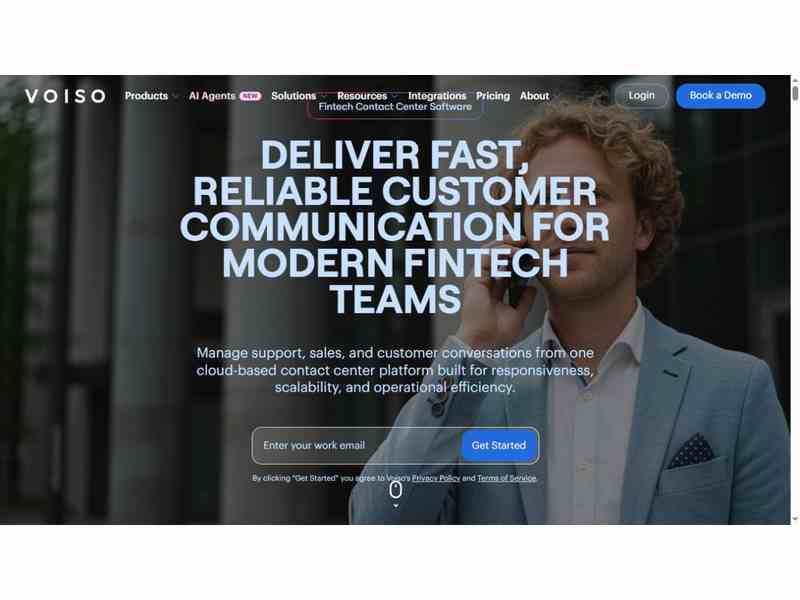
Voiso fintech contact center. Image: Voiso website.
The practical value sits in the relationship between those capabilities. A telephone call becomes more useful when the agent can see the relevant customer record, the outcome returns to the CRM, and a supervisor can find the conversation later. Voiso's product range addresses these connected steps, giving operations teams a way to organize communication as part of the wider client journey.
Where Voiso fits in a broker's technology stack
A brokerage typically separates client records, trading activity and customer communication across several systems. Voiso occupies the communication layer: agents make and receive calls, manage conversations and review interaction data, while connected business systems supply the customer context. This makes integration design central to its deployment. An accurate customer identifier and a reliable event flow are as important as the call interface itself.
Voiso's fintech page describes CRM-based access to client history, trading activity and preferences alongside calling, messaging and conversation logging. Those workflows depend on the connected CRM and the information made available to it. A broker can therefore define which records agents need to see, which actions they can take and where the resulting notes should be stored before extending the setup across teams.
A useful deployment starts with one concrete journey, such as a client requesting help with an account application. The service team needs the application reference, a clear owner for the request, and a record of the agreed next step. Connecting those items turns an isolated call into a task that another agent can understand and continue.
Outbound calling and campaign operations
Voiso's AI Predictive Dialer adjusts outbound dialing around agent availability and campaign data. Its supporting tools include answering machine detection, number validation and local caller ID. Together, they address different stages of an outbound operation: preparing a usable contact list, deciding when to dial, identifying an answering machine and presenting an appropriate calling number.
For an account-management team, this can support organized follow-up on customer requests or scheduled callbacks. Number validation helps improve the input list, while answering machine detection reduces the need for agents to handle every unsuccessful attempt manually. The browser-based WebRTC softphone provides the working interface for calls and SMS, allowing communication activity to sit within a cloud-based team setup.
Campaign design still determines the business outcome. A useful pilot separates contact attempts, answered calls, completed conversations and resolved requests. It also tracks repeat attempts and the reason for each follow-up. These measures show whether automation is helping the team complete useful work, rather than simply generating more dialing activity.
Local numbers and caller identity should be planned market by market. Teams need to establish number availability, the identity presented to recipients and the routing of return calls. The clearest customer experience is one in which the recipient recognizes the business, can return the call and reaches a team with access to the original conversation.
Messaging, web chat and customer continuity
Voiso's fintech solution names WhatsApp, Telegram and Viber alongside web chat, voice and SMS. Its omnichannel workspace is designed to bring conversations into a shared interface, with agents assigned to handle customer interactions. The company also describes fintech message templates and CRM-triggered messaging for use cases including account updates, KYC-related communication and service notifications.
For a broker, the operational opportunity is continuity. A customer may begin with a website enquiry, continue through a messaging application and later ask for a call. A shared workflow can help the team retain the request's context and route it to the appropriate owner. The implementation should make clear how a channel identity is matched to the customer record and how unresolved work passes between agents.
Event-driven notifications require particular attention to the source event. Where a message concerns trading activity or an account status, the connected business system needs to provide the correct event, recipient and timing. Voiso supplies communication tools; the broker's integration determines which business event initiates a message and what information the message contains.
Flow Builder and inbound service design
Flow Builder provides a visual interface for constructing interaction workflows. Voiso describes IVR menus, intelligent routing, call queues, text-to-speech and chatbot interactions within this part of the platform. These features give a service operation a common way to define what happens when a customer makes contact and how the interaction moves toward resolution.
A brokerage could organize an inbound journey around language, request type and team availability. An account-access enquiry may follow one route, while a technical platform question goes to a specialist queue. A chatbot can handle a defined self-service step before transferring the conversation to a person. These are deployment examples: the exact routing and data access need to be configured around the firm's own operating model.
The handover deserves as much attention as the initial menu. Agents should receive the customer's stated issue and any information already collected, with an explicit path for escalation. Testing after-hours requests, unanswered transfers and repeat contacts helps ensure the workflow remains useful beyond the ideal first-contact scenario.
AI Speech Analytics and supervisor workflows
Voiso's AI Speech Analytics offering includes call transcription, custom keyword lists, conversation scoring, summaries, sentiment analysis and topic identification. The product page describes support for more than ten languages, including English, Spanish, French and Arabic. These capabilities turn recorded conversations into material supervisors can search, review and use for coaching.
Each output serves a different purpose. Transcription makes spoken content searchable. Keyword flags help locate passages that deserve attention. Summaries provide a compact account of the discussion and next steps. Scoring helps structure review across a larger set of calls, while sentiment and topics can reveal recurring customer concerns. The strongest workflow connects these outputs to a specific operational response.
For example, repeated mentions of difficulty accessing an account can prompt a review of the support instructions or client-facing process. A supervisor can inspect the relevant recordings, establish what customers were trying to do and pass a concrete issue to the product team. The same review can identify useful examples for agent training.
AI outputs should support human review, particularly where the conversation contains specialized terminology, mixed languages or a disputed customer instruction. Keeping the original recording available alongside a summary allows a reviewer to check context. A pilot should include the languages, accents and vocabulary actually used by the broker's customers, with agreed criteria for when an item is escalated.
CRM connections and management visibility
Voiso lists integrations with HubSpot, Salesforce and Zoho, and its fintech page also names Leverate, Proftit and Panda Trading Systems. Described functions include click-to-call, conversation summaries, calling-list imports and logging interactions within CRM workflows. Its developer resources provide an additional route for teams planning application connections.
The integration discussion should focus on the complete data journey. Which system owns the customer record? How is an incoming caller matched? Does the call outcome return to the right account? What happens when two agents update a record? Answering these questions gives technical and service teams a shared definition of a working integration.
| Operational requirement | Relevant Voiso capability | Practical acceptance check |
|---|---|---|
| Organized outbound follow-up | Predictive dialer, number validation and answering machine detection | Track useful conversations and completed callbacks alongside attempts |
| Consistent inbound handling | Flow Builder, IVR and queues | Test routing, escalation and after-hours handling |
| Customer context across channels | Omnichannel workspace and CRM connections | Match identities and retain context during handovers |
| Conversation review | Transcription, summaries, keywords and scoring | Compare AI output with recordings in the team's working languages |
| Supervisor visibility | Real-time dashboards and reporting | Define consistent measures for activity, service and outcomes |
Real-time dashboards complement individual records by showing activity across the operation. Voiso describes more than 60 metrics and configurable dashboards. Managers can use this visibility to investigate queue pressure, campaign performance and agent workload, provided the team agrees on definitions and compares like-for-like periods and groups.
Building a controlled rollout
Voiso's fintech materials describe access controls, multi-factor authentication, number masking and call-recording encryption. For implementation teams, these features belong in the same design discussion as CRM access and conversation retention. A service agent, supervisor and administrator have different responsibilities; their access should reflect the information and actions each role needs.
A focused rollout can begin with one team, one customer journey and a limited set of channels. Establish the CRM mapping, calling numbers, routing rules, message ownership and review process, then test them with realistic cases. Expansion becomes easier once the business can demonstrate that a request reaches the right person, generates an accurate record and remains visible until it is resolved.
Voiso's breadth is most relevant to brokers that want voice, messaging and conversation intelligence to operate together. Its value is expressed through the everyday service process: agents understand the context, customers can continue a conversation across channels, and supervisors have the evidence needed to improve how the team works.
 Subscribe Now

