


What an Escalating Russia-Ukraine Conflict will Bring to Markets?
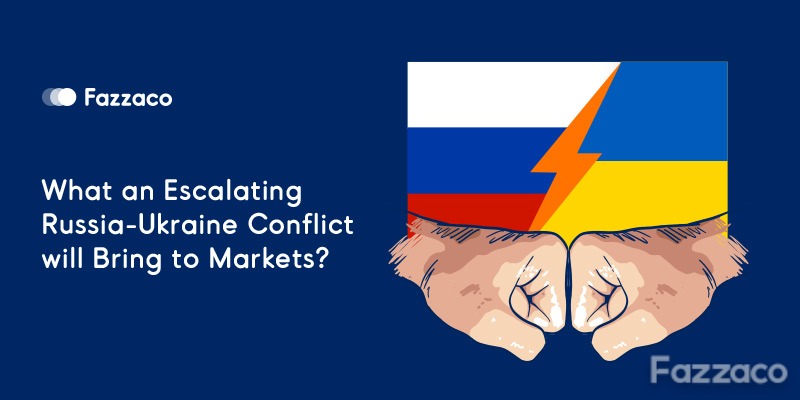
Following Russian President Putin's signing of decrees recognizing two controversial separatist-held regions, the Donetsk People's Republic and the Luhansk People's Republic, on Monday, Russian armed forces were then ordered to move into the territories for peacekeeping functions, just hours before the writing of the article.
Although western leaders believe that a Russian invasion is imminent, diplomacy will still be pursued "until the tanks roll".
- What the forex market has seen previously
Before the situation escalates, the forex market was already seeing moves from investors that usually indicate a major risk event. In late January, the euro/Swiss franc exchange rate hit the strongest level since 2015. The Swiss fiat money has traditionally been considered as a safe haven by investors, so the exchange rate is often deemed as the most important indication of geopolitical risk in the euro zone.
- No more Swift in Russia?
Western countries are fermenting an initial sanctions package for Moscow in face of the invasion. Among them, excluding Russian banks from Swift, which would effectively cut the country off from the global economy, has long been considered the ultimate sanction the West could take against Russia to deter it from taking further military action.
Rumors out there in January said that Swift-exclusion was no longer considered, but they were soon rejected by the White House, stating "no option is off the table. We continue consulting very closely with European counterparts on severe consequences for Russia if it further invades Ukraine." If that was the case, a great number of brokers would have been severely affected payment-wise.
Despite that, the White House still admitted, at a press briefing, that it is probably not going to be the case that we'll see SWIFT in the initial rollout package.
- Legalizing crypto
The opposition between Russia and Ukraine is not just military, but about legalizing crypto as well.
Russian government's take on cryptocurrencies has always been iron-handed in spite of the growing crypto market in the country. A total ban on digital assets trading and crypto mining across the country was even advocated lately.
Nevertheless, in January, Binance still considered to expand its presence in Russia as they believed it would be a strategic move for the company.
Ukraine, on the other hand, has been on the crypto's side, along with other former Soviet states including Kazakhstan and Uzbekistan, where they are taking steps towards liberalization, rather than restriction.
In fact, the Ukrainian parliament just passed a bill last week, to legalize cryptocurrency, preparing a framework for the regulation and management of digital assets like Bitcoin.
- Is Russia facing a complete financial cutoff from the rest of the world?
"Russia would in principle be cut off from the international financial markets, all goods we make that Russia urgently needs to modernise and diversify its economy, where we are globally dominant and they have no replacement," said European Commission President Ursula von der Leyen last week.
She said sanctions would not be imposed until after any invasion, rejecting calls on Saturday by Ukrainian President Volodymyr Zelenskiy for immediate sanctions.
A complete financial cutoff from the rest of the world would undoubtedly be an event of coup de grace for the entire financial services sector of Russia.
Countries of the post-Cold War world, especially big powers, are treading more carefully when it comes to disputes, while some news media are all about exaggerated facts and selective reporting. Therefore, the sanctions the West prepared for Russian invasion this time, may just be something similar to all the sanctions they had been imposing on Russia all these years. It is not a wise move to corner a nuclear power to a cul-de-sac.
 Subscribe Now

