When people talk about Forex trading, two of the most common terms we hear are liquidity and volatility. But what are they exactly? Let’s take a closer look. Liquidity
Liquidity refers to how active a market is. It is determined by how many traders are actively trading and the total volume they’re trading.
One reason the foreign exchange market is so liquid is because it is tradable 24 hours a day during weekdays.
Naturally, more popular currency pairs such as the EURUSD will have a lot more liquidity than exotic pairs that are niche or special, such as AUDNZD. But the liquidity of pairs also depends on what time of the day, or in what season we are in.
For example, if there is a holiday in Japan, then Japanese traders won’t be trading. So there will be less liquidity in the USDJPY. There is more liquidity when there are more traders, so while Europe and the US markets are open, there is more liquidity in all pairs than when just Australia is open.
Volatility
Volatility is the measure of how drastically a market’s prices change. Price movements can vary from hour to hour, minute to minute, and second to second, depending on many factors.
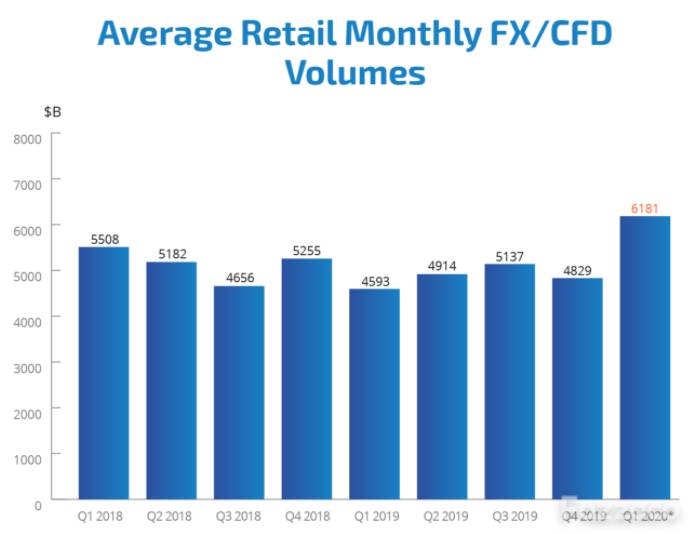
In 2020, amid a global health and economic crisis caused by the spread of COVID-19, the FX market is experiencing heightened levels of volatility and thinner liquidity.
Many brokers started to feel the impact of coronavirus related volatility and saw a significant uptick in trading volumes.
(Source: Magnate)
Relationship between liquidity and volatility
A market’s liquidity has a big impact on how volatile the market’s prices are. The degree of a market’s volatility affects its volatility, and in turn, affects its drastic price changes.
Commonly, lower liquidity usually results in a more volatile market and cause prices to change drastically; higher liquidity usually creates a less volatile market in which prices don’t fluctuate as drastically.
However, it should be noted that drastic and sudden movements are also possible in the forex market. Since currencies are affected by so many political, economical, and social events, there are many occurrences that cause prices to become volatile.
Liquidity and volatility are important terms to get your head around before you throw yourself any more directly into the forex markets.



 When people talk about Forex trading, two of the most common terms we hear are liquidity and volatility. But what are they exactly? Let’s take a closer look.
 Subscribe Now