


When Rights Stop Trading on the Saudi Exchange, Can Holders Still Subscribe?
On 9 September 2026, an investor who held rights in Naseej International Trading Company could still subscribe for new shares. Selling the rights on the Saudi Exchange (Tadawul) was already off the table. The previous day had been the last trading day for the rights. Subscription remained open until 13 September. For a broker displaying the position in a client portfolio, a single label saying “closed” would have obscured the one choice that remained.
The Saudi Exchange operates the market in which these rights change hands and publishes issuers’ corporate-action notices. In a rights issue, the listed company sets the terms for raising capital. The exchange gives the right its own trading code. That separation lets a shareholder sell an entitlement while keeping the underlying shares, and lets another investor acquire the entitlement without first owning the stock.
What changes hands when a right trades?
Each right gives its holder the option to subscribe for one new share at the offer price. When a buyer purchases the right, the money paid on the exchange buys that entitlement. Exercising it requires a subscription instruction and a separate payment for the new share. A broker’s trade confirmation can therefore be perfectly accurate even though no new shares have been subscribed for.
Consider an illustrative quote. The offer price is 10 Saudi riyals per new share and the existing share trades at 14 riyals. On the exchange’s definition, the right has an indicative value of 4 riyals, the difference between those prices. The price available in the rights market comes from buy and sell orders. Suppose an investor can buy 100 rights at 3.80 riyals each. The purchase costs 380 riyals. Exercising all 100 then takes another 1,000 riyals, for a combined outlay of 1,380, before charges. The share and rights quotes here are hypothetical. Only the 10-riyal offer price is taken from Naseej’s issue.
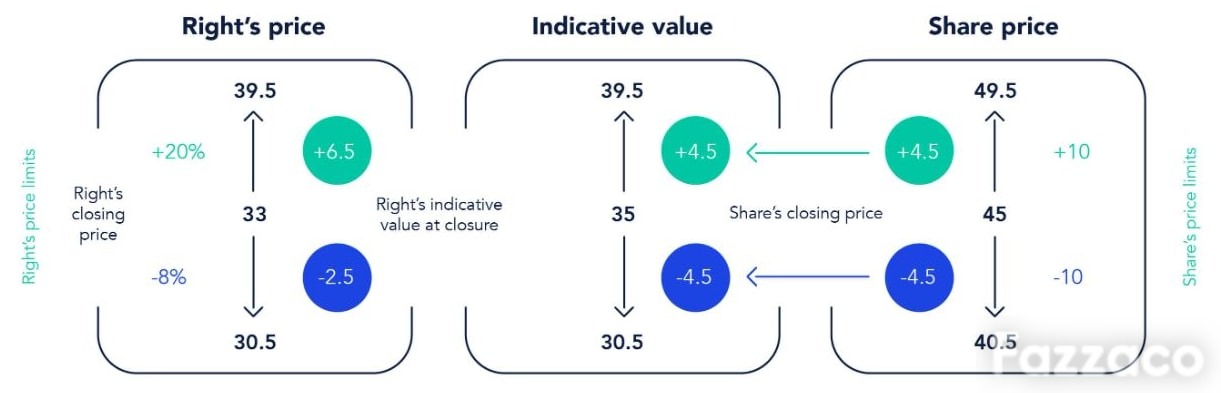
In the Saudi Exchange’s own teaching example, the right closes at 33 riyals against an indicative value of 35. These figures illustrate how the two can differ.
The distinction matters even if a client never looks at an indicative value. A client who has funded only the 380-riyal purchase can hold 100 rights but still needs the subscription money. A portfolio screen can show the number of rights alongside the amount due to exercise them. Showing only the market value leaves the second cash requirement out of sight.
One opening day, two deadlines
Naseej’s notice opened both trading and subscription on 1 September. Trading ended on 8 September. The period through 13 September gave eligible holders time to submit their subscription instructions. The prospectus also specified that a buyer of rights could subscribe after the purchase settled, a process it described as taking two business days. A newly executed purchase and a settled entitlement available to exercise were therefore different positions for the broker to track.
A dated client notice could make this concrete. On 8 September, it could identify the last opportunity to sell during market hours. On 9 September, a holder with settled rights still needed the subscription deadline and the amount payable. The underlying stock price might continue to move in between, but a price update could neither reopen the rights market nor submit a subscription for the client.
Where the unused rights showed up
The issuer’s 14 September announcement gives the other side of the portfolio record. Of 16,345,951 shares offered, investors subscribed for 13,379,908, or 81.85%. At 10 riyals a share, those subscriptions amounted to 133,799,080 riyals. The difference was 2,966,043 shares. Naseej designated those shares for a separate offering to institutional investors, who could submit bids at or above the offer price.
Those figures are a count of subscriptions across the issue. They say nothing about how many times a particular right changed hands on the exchange. For the client who bought 100 rights, the records that answer the question “Did I get the shares?” are the settled entitlement, the subscription instruction and the resulting allocation. A record of the 380-riyal purchase answers an earlier question: who bought the right to apply?
 Subscribe Now