


Which Market Feed Arrived First? Reading Cisco’s Exablaze Timestamps
A broker’s market-data recorder writes a quote from feed B to disk before its copy from feed A. Which feed reached the rack first? If both passed through the high-precision switch that Cisco acquired with Exablaze, the answer may be in the timestamps attached to the packets. Reading down the capture file can give the opposite answer. The distinction matters to a desk deciding whether to investigate a slow feed, a congested recorder or a change in its own network.
From ExaLINK to Cisco Nexus
Exablaze was an Australian designer of network hardware for applications sensitive to delays. Its portfolio included switches built around field-programmable gate arrays and network adapters for servers. Cisco announced the acquisition in February 2020. The old names still matter when a network team inherits a rack or opens a capture made before the acquisition. A chassis label, an invoice and the current manual can all refer to the same piece of equipment in different terms.
Cisco maps ExaLINK Fusion HPT to Nexus 3550-F Fusion HPT, the high-precision timestamping model. The Fusion Layer 1 switch, Layer 2 switch and multiplexer each have their own entries. The former Hydra switches belong to the 3550-H family. An ExaNIC X25 is a server adapter that Cisco lists under Nexus SmartNICs. A parts list that says only “Exablaze” therefore leaves two questions open: which device observed the traffic, and where was it installed? A time recorded at the rack switch describes a different point in the journey from one recorded at a server.
The observation point is the switch input
The Fusion HPT guide illustrates two incoming ports, A1 and B3, feeding a mirror output at C3. A mirror sends a copy of the observed traffic to a recorder. For traffic entering the HPT mirror, Cisco describes a timestamp taken as each packet arrives at the input, at a resolution of 100 picoseconds. The copy also carries identifiers for the device and input port. Those identifiers allow the analyst to separate the two streams again when both reach a single recorder.
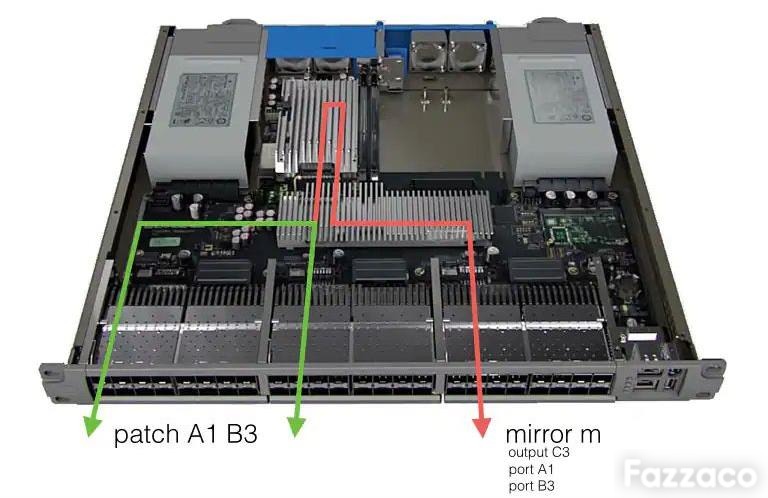
Cisco’s diagram follows ports A1 and B3 to mirror output C3.
Consider what the broker can investigate at that point. A quote has travelled from its source to A1. The switch timestamps the arrival, and a copy travels from C3 to the recorder. Later, an application consumes the quote and may send an order. The ingress timestamp puts a time on the first of these local observations. A claim about how long the application took to react needs a second observation at the application or order boundary. A claim about transit from the venue needs a comparable time from the venue and an understanding of how its clock relates to the broker’s.
Reconstructing the order of two copies
Suppose the same identifiable update arrives on A1 at 10:00:00.000001200 UTC and on B3 at 10:00:00.000001900 UTC. In this illustrative case, the A1 copy arrives 700 nanoseconds earlier at the switch. The operator might nevertheless find B3 first in the file. Cisco documents that packets from an individual mirror input retain their timestamp order at output. Packets from different inputs can interleave differently. File position tells the operator how the copies came out of the monitoring path.
To reproduce the comparison, keep the original capture and make a working view with columns for event identity, device, ingress port and ingress time. Match copies using the feed’s identifiers where those identifiers are comparable. A repeated price alone is ambiguous: the same bid might occur in several successive updates. Sort the matched copies by ingress time and retain their original file positions. Another analyst can then see both what arrived first and why reading the file from top to bottom suggested something else.
The example also sets a limit on the conclusion. One matched pair establishes an arrival difference for that update. To decide whether a line is persistently slower, a desk needs a series of comparable updates, with missing copies counted separately. If a copy is absent from the record, its arrival time is unknown. Treating the absence as an infinitely slow delivery would mix availability and timing in the same statistic.
A fine timestamp still needs a common clock
Resolution describes the increments the equipment can record. Two clocks can both record fine increments and still disagree on the time. With A1 and B3 on the same switch, an offset common to its clock affects both observations. Moving B3 to a second chassis changes the comparison. An offset of one microsecond between the two clocks is larger than the 700-nanosecond difference in the example. Depending on its direction, it could even reverse the apparent lead.
Cisco’s system-time guide uses UTC and describes several synchronization choices, including GPS and the Precision Time Protocol. It also identifies early units without the onboard GPS receiver. That detail matters to a team building a record of what was deployed: the model family alone does not identify the clock source in use. Record the serial number, the selected reference and evidence of synchronization covering the period in question. A photograph of an antenna connection taken today cannot establish clock alignment during yesterday’s incident.
When the recorder is the bottleneck
Bringing two inputs together creates a capacity question even if each input runs within its own limits. Imagine that each contributes a sustained 6 Gb/s of traffic to one 10 Gb/s capture output. Together they demand 12 Gb/s before allowing for the metadata attached to the copies. A buffer can absorb a short burst. It cannot carry a sustained excess of 2 Gb/s indefinitely. Cisco describes distributing mirror output across ports when the aggregate load exceeds a single output’s capacity. The receiving system also has to keep up with what it is sent.
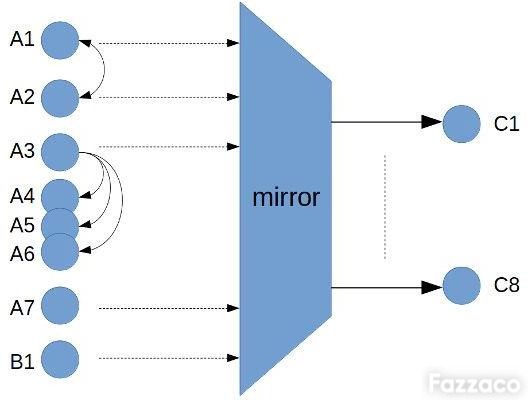
Cisco’s logical view distinguishes the mirror inputs from its output ports.
A useful incident record therefore distinguishes three observations: what a feed handler processed, what the switch observed at an input, and what the recorder retained. If a handler processed an update that is missing from a congested capture, the record is incomplete evidence of the handler’s experience. If both independent records show the same sequence gap, the investigation can move upstream. Mapping the recorder and the application to their actual paths helps the desk decide which evidence to collect next.
What a support date means for an installed rack
Cisco’s amended lifecycle bulletin covers specified 3550-F and 3550-H switches and accessories. It lists 10 April 2023 as the last order date. The deadline for ordinary software maintenance and the deadline to attach previously uncovered equipment to a new service contract both fell on 9 April 2024. For eligible existing contracts, the final renewal date is 6 July 2027. The bulletin sets 30 April 2028 as the last date of applicable support and lists no direct replacement. An individual unit’s entitlement still depends on its coverage. The bulletin identifies affected part numbers, so an ExaNIC adapter requires a separate lifecycle check.
For a broker planning a move, the handover should include a sample capture as well as a hardware inventory. Give the incoming team a pair of identifiable updates, the switch and port that observed each, the clock reference, and the expected time difference. Have it repeat the comparison on the proposed capture path and explain any missing copies. That exercise tests whether the desk can carry a historical measurement forward when the device producing it changes. A replacement that forwards live quotes successfully still has to preserve the evidence the desk uses when something goes wrong.
 Subscribe Now