Add Fazzaco to desktop

Add Fazzaco to desktop

Access Fazzaco from desktop next time

Add now
English

Who Has Obligations To Meet MiFIR Trade Publication Requirements?

Source: TRAction Fintech

64da837c01d8312b08cd101c45939f0.jpeg
Articles 6, 10, 20 and 21 of MiFIR requires European Investment Firms (“IFs”), Systematic Internalisers (“SIs”) and Trading Venues to make public, through an Approved Publication Arrangement (“APA”), post-trade transparency information in relation to financial instruments which are traded on a Trading Venue or traded Over-The-Counter (“OTC”)/Off Exchange. The obligation only requires one counterparty to report the trade data. Where the transaction is executed on an European Economic Area (“EEA”) Trading Venue, the market operators or Investment Firm who operate the Trading Venue have the trade reporting obligations (Article 12 of RTS 1).
Where the transaction is executed outside the scope of an EEA Trading Venue, it could be difficult to determine who has the reporting obligation.  We review some common scenarios and identify which party has the obligation to report post-trade transparency data.
A transaction is executed outside of an EEA trading venue
In ascertaining who has the obligation to report under Article 20 and 21 of MiFIR, ESMA published a number of Regulatory Technical Standards (“RTS”) to provide some guidance. For instance, Section 5 of Article 12 states the seller has the obligation to report the trade data, subject to the following reporting hierarchy.
43ee4455cb4165ea96af260dda08ef8.jpeg
1. Systematic Internalisers (“SIs”)
Scenario Buyer Seller Who has the obligation to report?
(a) SI SI SI Seller
(b) SI IF SI
(c) IF SI SI
As shown in scenario (a), if both investment firms are SIs, the seller has an obligation to report the post-trade transparency data (section 15 of RTS 1).
However, where the investment firm is a SI and it entered into a transaction with another non-SI investment firm which refers to scenario (b) or (c) above, the SI will make the transaction public through an APA regardless of which side it is acting for (Article 12(5) of RTS 1 & Article 7(6) of RTS 2).
2. Investment Firms (“IFs”)
Scenario Buyer Seller Who has the obligation to report?
(a) EU IF EU IF EU IF Seller
(b) EU IF Non-EU IF EU IF
(c) Non-EU IF EU IF EU IF
As illustrated in scenario (a), if a transaction is executed between two investment EU IFs, the seller is required to make the transaction public through an APA (Article 12(4) of RTS 1 & Article 7(5) of RTS 2). If the financial instrument is entered between an EU IF and non-EU IF, the reporting obligation will rest on the EU IF regardless of which side they are acting for.
If both sides are non-EU IFs, they would be out of the scope of reporting obligations under MiFIR.
3. Retail Clients
Scenario Buyer Seller Who has the obligation to report?
(a) EU IF Retail Client EU IF
(b) Retail Client EU IF EU IF
When a transaction is executed between an EU IF and a retail client, the obligation always rests on the EU IF, as a Retail Client is out of the scope of reporting obligations under MiFIR . For more information, find the Questions and Answers on MiFID II and MiFIR transparency topics published by ESMA here.
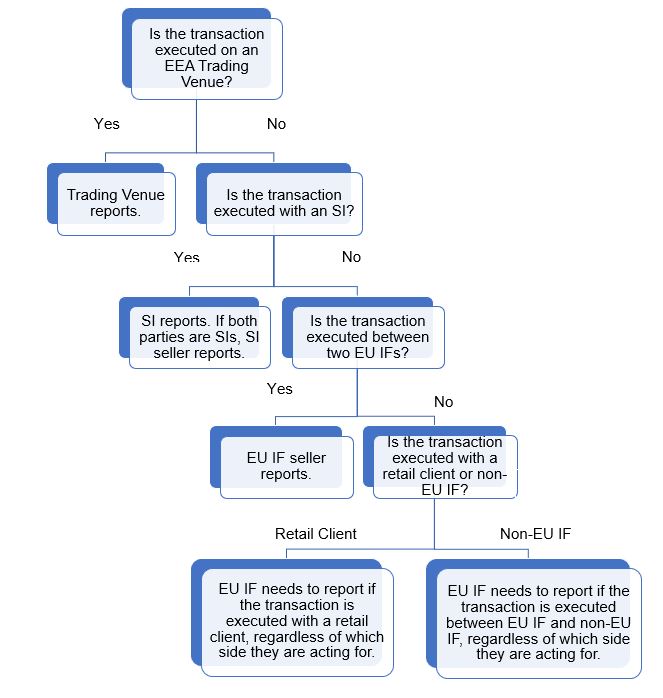
We have created a tree diagram below to help you determine who has the reporting obligation under MiFIR Trade Publication. (This is only applicable to products that are traded on a trading venue or traded off exchange, and therefore not applicable to products where only the underlying is traded on a trading venue, such as non-venue traded CFDs.)
When does the post-trade transparency information need to be reported by?
Post-trade information shall be made available as close to real time as is technically possible (Article 7 (4) of RTS 2):
  1. on or before 3 January 2021, post-trade data must be made available to public within 15 minutes after the execution of the relevant transaction;
  2. after 3 January 2021, post-trade data must be made available to public within 5 minutes after the execution of the relevant transaction.
What needs to be reported?
The following needs to be reported in a post-trade transparency report:
  1. Trading date and time;
  2. Instrument identification code;
  3. Unit price;
  4. Price currency;
  5. Quantity;
  6. Venue of execution;
  7. Publication date and time;
  8. Venue of Publication;
  9. Transaction identification code.
For more details see Table 3 of Annex I of the RTS 1.
Emma Ladlow Emma works in our Sydney office. She works on implementing changes to regulations, improving and expanding regulatory reporting offered by TRAction and helping with new business initiatives. She has 4 years’ experience in transaction reporting and 7 years’ experience in the finance industry.  She worked for one of the largest financial services organisations in the UK and then moved to Australia in November 2018 to join TRAction.

CFD

Create Company Page