


Why You Shouldn't Worry About Tier-1 Banks as Your Counterparty?

Forex traders tend to avoid B-book brokers as trading against customers is synonym to "forex scams" or "fraud". Traders' fear lead to a growing number of non-dealing desk brokers, i.e. those who labeled them with STP/ECN. They relay the orders to the international forex market and profit from spreads or commission in stead of involving in the transaction.
Nevertheless, such an attitude is unfair for B-book forex brokers, provided that they don't manipulate user data or create any slippage artificially.
Anyway, even you are trading with an authentic STP/ECN broker, your trading orders will be ultimately executed by a liquidity provider, which is also trading against you. Then, as the top player in the capital market, do tier-1 liquidity providers manipulate your data or get more profits from under-table operation?
The answer is short and clear: NO, with a very simple reason: They are soooooo big that they don't care about a drop in the ocean.
Tier-1 banks cover a wide range of business. Even in weekends when the market does not open for retail traders, their business keeps going. Fabricating transaction data is like a mug's game, as they are facing competition from top-rated banks and financial institution and are supervised by national-level regulatory bodies. A small mistake may collapse its reputation and leads to inferior position in competition.
Generally speaking, forex trading business, including spot and forward, is a part of IFCC business, in which FI refers to fixed income (interest rate, debt, L/C, etc), C stands for currency, and C for commodities (metal, energy, agricultural products).
The figures below show that currency revenue only takes a small share in tier-1 banks' FICC service from approximately 8% to 66.7%. It should be noted that the currency business include institutional and retail forex trading, and the latter only accounts for 5.5% in total trading volume in the forex market.
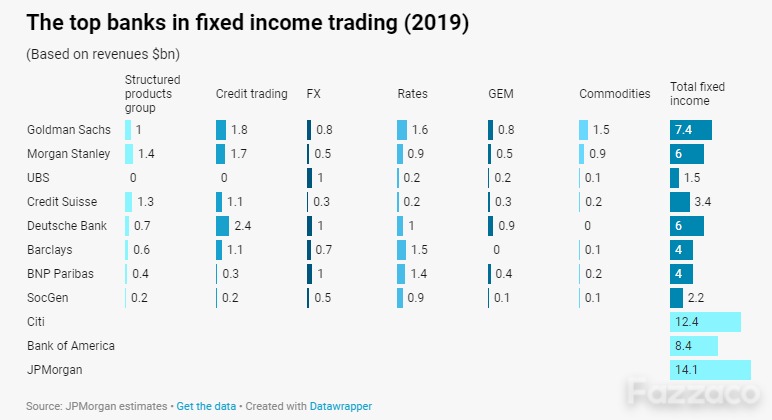
Let's take UBS as an example. UBS achieved a total revenue of 35.15 billion USD in 2019, with 15 billion USD in FICC (4.26%). It can be reckoned that retail forex trading only accounts for 0.5% in UBS' total revenue, based on the 5.5% proportion mentioned above.
Similarly, Morgan Stanley registered 41.42 billion USD revenue in 2019, with only about 1.2% coming from retail forex trading.
Calculation above indicates how gigantic and powerful these banks are, which is in stark contrast to small forex start-ups, as the latter may resort to white label or even gray label due to limited budget. They may target at customers' principal instead of seeking long lasting revenue from spreads or commission.
In a nutshell, it's not worth for tier-1 banks to risk their reputation and brand credit to seek small gains, as the proverb goes, "penny wise and pound foolish". So don't worry about them as your trading counterparties. They are the ones that make your deal a deal.
 Subscribe Now