


Worldline Direct: What Happens to the Rest of a Card Authorisation?
A customer sees €100 disappear from the available balance on a card. The merchant sees an approved transaction. Has the merchant collected €100? With Worldline Direct, the answer depends on what the merchant asked the processor to do at checkout. An authorisation reserves spending capacity. Capture is the instruction to collect the money. A finance team looking for a bank deposit has a third question to answer: when did the acquirer pay out?
One checkout, two possible instructions
Worldline provides payment services to merchants. Its Direct platform lets a business take online payments through a hosted checkout or an API integration. For a card transaction, the merchant can request a sale, which combines authorisation and capture, or separate the two steps. That choice reflects a business decision: does the merchant know precisely how much it is entitled to collect when the customer presents the card?
Consider a hypothetical subscription business selling a €100 annual data package. If the full package becomes available immediately, the order amount and the amount due coincide. A sale can express that in one instruction. If activation depends on approval by a separate team, the merchant may instead want to reserve the sum while the application is pending. Worldline distinguishes final authorisation, which requires a full capture if the merchant decides to collect, from pre-authorisation, which can support a lower capture amount. Payment method, issuer, merchant activity and acquiring agreement can all affect the options available and the life of a hold.
What happens to the other €30?
Suppose the same customer orders two services for €70 and €30 under one eligible €100 pre-authorisation. The first service is delivered today. On Worldline Direct the merchant can refer back to the original payment ID and specify the €70 it wants to capture. There is a second choice alongside the amount. The isFinal setting tells Worldline whether to close the transaction to further captures. If the second service is still due and multiple captures are supported, leaving it open preserves the possibility of collecting the remaining €30. Marking the €70 capture final closes that route.
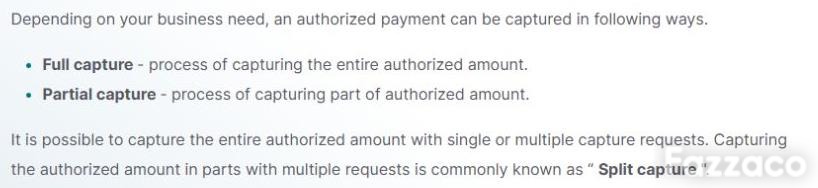
Full and partial capture in Worldline acquiring documentation.
Two orders can therefore show identical €70 capture amounts yet require different actions from support. In one, the €30 service was abandoned and the collection is complete. In the other, the customer is waiting for delivery and the merchant may still need a second capture. A support screen that shows only the order total and the amount collected conceals the distinction. Retaining the original payment ID, the amount of each capture and whether the last instruction closed the transaction lets an operator reconstruct what actually happened.
Which record answers the customer's question?
Worldline labels status code 5 as authorised and code 9 as payment requested. Between those stages, code 91 means the merchant has requested capture and is waiting for the acquirer to respond. The acquirer may still decline the request. If a customer asks why a card’s available balance fell, the authorisation record is relevant. If operations needs to explain the €70 charge, the capture against the original ID provides the amount and its context. If treasury is missing a credit on the bank statement, the acquiring settlement and payout records become relevant. Calling each of those stages “paid” invites the three teams to give different answers about the same order.
There is also a practical difference between cancelling a hold and refunding a charge. Before capture, cancellation releases the reserved amount under the applicable rules. After collection, returning money involves a refund. In the €100 example, reporting the uncollected €30 as a merchant refund would create an outflow in the internal ledger for money the merchant never collected. Keeping the order, the reservation and the captured amount distinct gives the customer a more precise explanation and leaves finance with an entry it can reconcile.
 Subscribe Now