


Worldpay for Forex Brokers: Acquiring, Payouts and Payment Operations
For a forex or CFD broker, payment infrastructure is part of the client journey rather than a back-office afterthought. A trader may judge the platform by how clearly a deposit is confirmed, how reliably a withdrawal is tracked, and whether a preferred local method is available. Worldpay is listed in Fazzaco’s company directory as a forex payment provider. Its public product portfolio spans acquiring, online acceptance, payouts, fraud assessment and 3-D Secure (3DS) authentication. The useful B2B question is how those components could fit a particular broker’s licensed entities, customer markets and operating model.
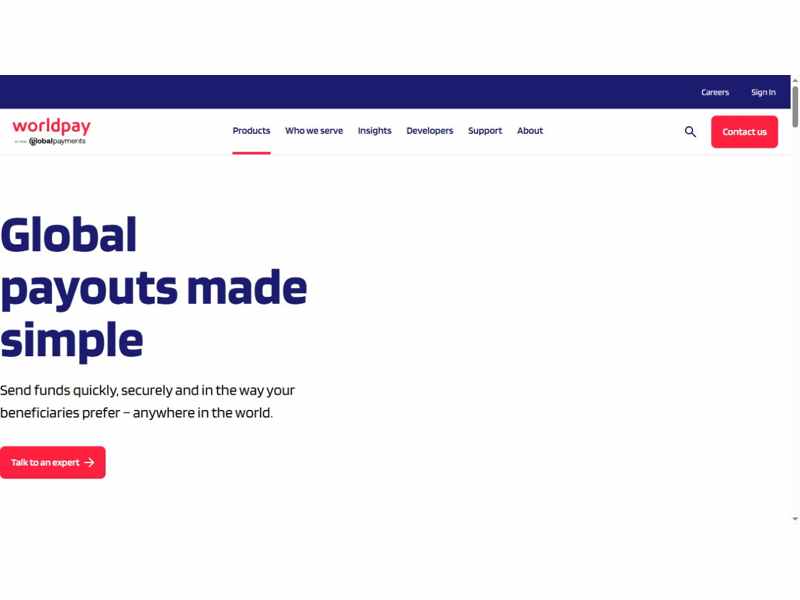
Screenshot of Worldpay's official payouts page, verified 8 October 2026.
What Worldpay supplies—and what its public pages do not establish
Worldpay describes itself as a payments provider with global acquiring and online-payment products. Its published payout materials cover transfers to bank accounts, cards and wallets, while developer documentation describes separate account-payout, card-payout and wallet-payout API families. FraudSight supplies risk assessment, and its 3DS tools support cardholder authentication. These are distinct capabilities; buying an acquiring service does not automatically mean every payout rail or risk product is included in the same commercial agreement.
Worldpay’s public product pages are not a broker-specific contract. They do not confirm that a particular forex or CFD legal entity will be onboarded, that every payment method is available for trading accounts, or that a named country, card scheme and currency combination will be approved. A broker should obtain written entity-level eligibility, permitted transaction types and processing terms before designing a customer-facing payment promise around any provider.
Pay-in design: from checkout to reconciled trading balance
Worldpay’s global-acquiring page presents online acceptance and multicurrency products. In a broker setting, a pay-in journey begins when an authenticated customer requests a deposit in the trader area. The payment screen needs to show the available method, currency, any conversion, and the point at which the platform treats funds as received. The broker’s ledger must then match payment-provider events to a unique client and deposit instruction; a successful browser redirect alone is not a sufficient accounting event.
That distinction matters when an authorization succeeds but capture, settlement or a later reversal follows a different path. Product and operations teams should define the status mapping for pending, authorized, captured, failed, refunded and disputed payments. They should also test duplicate callbacks, retries and manual adjustments. Worldpay’s general online-acceptance capability is relevant to this workflow, but the exact event model and integration route require technical confirmation against the chosen product and merchant configuration.
Withdrawals: separate the client instruction from the payout rail
Worldpay’s payout offering describes distribution to bank accounts, cards and wallets. Its developer pages document account payouts, including single and batch instructions and payout search, alongside other payout API families. For a broker, this suggests possible architecture for sending approved withdrawals through a payment provider. It does not remove the broker’s own obligations to verify the customer, approve the withdrawal, check account ownership, apply internal risk controls and reconcile the completed transfer.
Procurement should distinguish payout creation from delivery. The user interface needs a meaningful chain of states: requested, reviewed, submitted, accepted by the rail, paid or returned. Where a payout fails, operations needs an exception queue, a reason code and a way to avoid paying twice after a retry. Worldpay publishes various delivery options and geographic reach on its product page, but live routes, cut-off times, funding currencies, fees and service-level commitments must be validated for the broker’s exact corridors. Do not convert a provider-wide marketing range into a promise to individual traders.
FraudSight and 3DS in a broker payment stack
FraudSight is Worldpay’s risk-assessment product. Its documentation describes both an assessment integrated into a payment flow and a separate assessment request. The latter may matter to a group using more than one gateway, although data-sharing, coverage and configuration would need review. For broker deposits, a fraud signal can support an internal decision; it should not be mistaken for a complete client due-diligence or anti-money-laundering program.
Worldpay’s 3DS documentation describes cardholder authentication intended to reduce fraud and, where applicable, support Strong Customer Authentication requirements. A broker should ask how challenge and frictionless flows appear in its own deposit UI, what happens when authentication is unavailable, and how the final authorization response is recorded. Fraud screening and authentication are related but different controls. Neither proves that all chargebacks, account-takeover attempts or payment disputes have been eliminated.
Currency, regional coverage and entity structure
Cross-border payment availability is a matrix, not a single number. A group may have several operating entities, brands and client segments. Each entity can have different merchant arrangements, local rules, settlement currencies and permitted payment methods. Worldpay presents multicurrency and global-acquiring solutions, while its payout pages describe multiple funding and recipient options. The broker still needs a country-by-country and entity-by-entity answer for the flows it plans to offer.
Before implementation, request a written matrix covering customer location, merchant-of-record entity, deposit method, payout destination, transaction and settlement currencies, FX conversion point, reserve terms and expected evidence at onboarding. Include restrictions on third-party payments and the handling of refunds to the original funding source. The objective is to ensure the website’s payment-method display matches the contracted and technically enabled reality for each client cohort.
Integration and operational ownership
Worldpay publishes developer documentation for its products, including payout APIs and fraud tools. An engineering team should use those documents to identify the applicable API family, credentials, test environment, idempotency controls, webhook or event handling, and error taxonomy. The selection of a product family precedes detailed implementation: a card payout is not the same operation as a bank-account payout, even if both appear to the trader as a withdrawal.
Ownership also needs to be clear between payments, compliance, finance and customer support. A payment integration is incomplete if operations cannot trace a trader’s deposit from initial instruction to ledger credit, settlement and potential dispute. A reconciliation file or API feed, consistent identifiers and a daily exception process are as important as a functioning checkout. During a pilot, test failures and reversals deliberately, rather than checking only a successful payment.
A practical vendor due-diligence table
| Area | Question for Worldpay and the broker team | Evidence to obtain |
|---|---|---|
| Eligibility | Which licensed entity, brand and trading activity can be contracted? | Written underwriting and permitted-use terms |
| Coverage | Which pay-in and payout methods work for each corridor? | Entity/country/currency/method matrix |
| Economics | What are acquiring, payout, FX, dispute and reserve costs? | Contract schedule and sample settlement reports |
| Operations | How are callbacks, returns, disputes and retries reconciled? | API/event specifications and pilot test cases |
| Controls | Which FraudSight, 3DS and validation services are included? | Product configuration and responsibility map |
This checklist is an editorial procurement framework, not a claim that Worldpay has already passed a broker-specific assessment. It helps a buyer compare a proposal with the operational outcome it needs: deposits credited correctly, withdrawals controlled and visible, and exceptions resolved without ambiguity.
Who may find the platform relevant?
Worldpay may merit evaluation by established brokers with material online card acceptance needs, cross-border customer bases or a requirement to join acceptance and payout operations to a broader payments program. A group evaluating multiple jurisdictions may value the breadth of product families and documentation. A smaller broker with one corridor and a limited engineering team may instead focus first on implementation effort, minimum commercial commitments, reporting usability and the availability of a supported integration partner.
There is no universal fit decision. Merchant approval, deployment timing, terms and coverage are specific to the applicant. A sensible shortlist compares Worldpay with alternatives against the same merchant entities and transaction scenarios; it should not rely on the provider’s general scale, a directory rating or an unverified performance claim.
Bottom-line assessment for a B2B buyer
Worldpay’s publicly documented offering gives a broker several relevant building blocks: online acquiring, multicurrency payment services, bank/card/wallet payout families, fraud assessment and 3DS. The potential value lies in assembling the right combination for the broker’s real deposit and withdrawal journeys. The decisive evidence remains a live, entity-specific proposal and a controlled technical pilot, not a product-page feature list.
Fazzaco’s view is to evaluate payment providers through eligibility, corridor coverage, reconciliation, exception handling and commercial clarity. Before offering a new method to traders, the broker should confirm its contracted availability and test both success and failure paths. Readers can consult Worldpay’s acquiring overview, payout product page, account-payout documentation, FraudSight documentation and 3DS documentation for the provider’s own descriptions.
 Subscribe Now