


X Open Hub and XTB Institutional: Liquidity and Bookshare Models
X Open Hub is the institutional business now presented under the XTB Institutional brand. Its current offering centers on wholesale FX and CFD liquidity for brokers, banks and selected professional counterparties. The business combines multi-asset coverage with institutional connectivity and commercial models structured around a partner's trading flow.
The change in brand also changes the starting point for understanding the offer. X Open Hub's historical materials covered trading platforms, back-office tools and white label technology. The current XTB Institutional website gives greater prominence to liquidity, Bookshare models and institutional cooperation. For a broker evaluating a partnership, the useful distinction is between the historical technology portfolio and the specific service included in a current proposal.
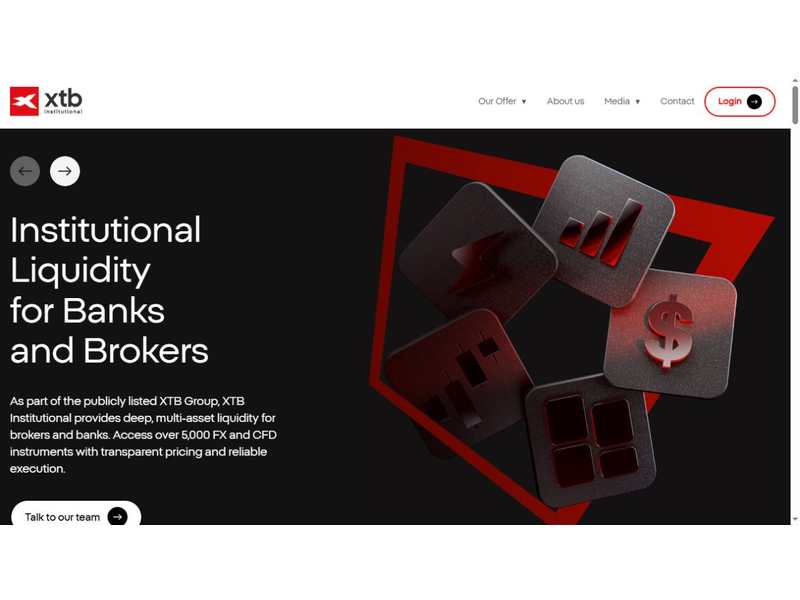
XTB Institutional official website: institutional liquidity.
From X Open Hub to XTB Institutional
The official company timeline identifies the launch of X Open Hub for institutional clients in 2012 and a rebranding and transition to XTB Institutional in 2026. The former website directs visitors to the new institutional site. The current company description places operations in Warsaw and identifies the business as part of XTB Group.
This continuity is relevant to firms that know the X Open Hub name from earlier technology integrations or industry relationships. A change in branding does not, by itself, specify a change to every product, contract or connection. Those details belong in the partner's actual service documentation. The current institutional site provides the more appropriate reference for a new commercial discussion.
The website describes its audience as brokers, banks and selected fintechs. It also explicitly frames its liquidity business as a wholesale model for professional counterparties, including licensed institutions offering CFDs and other leveraged instruments to their own clients. This is a B2B supply relationship, with requirements shaped by the counterparty's business and trading activity.
Multi-asset liquidity gives brokers a common supply relationship
XTB Institutional advertises access to more than 5,000 instruments across FX, indices, commodities, shares, ETFs and crypto CFDs. This is the provider's published scope, rather than a guarantee that every instrument is available on identical terms to every counterparty. The actual list, account configuration and commercial agreement determine the universe a broker can deploy.
The operational attraction of multi-asset coverage is that a broker can discuss several product categories within one institutional relationship. Expanding a retail offering, however, involves more than adding symbols to a platform. The broker needs to align instrument specifications, trading sessions, contract sizes, client-facing descriptions and its internal reporting with the proposed liquidity setup.
The current liquidity page offers an instrument list and a liquidity brochure. These are useful inputs for defining a product universe. A broker can begin with the instruments its clients actually trade, then map the provider's coverage to that demand. This creates a more precise assessment than treating the headline number of instruments as the only measure of suitability.
| Area | Current published scope | Operational significance |
|---|---|---|
| Institutional audience | Brokers, banks and selected professional counterparties | A wholesale relationship with defined onboarding and terms |
| Asset coverage | FX and CFDs across several asset classes | A common discussion for product coverage and account configuration |
| Liquidity | Deep order book and aggregated market depth | Assessment of executable pricing for the intended flow |
| Connectivity | Flexible institutional connections | Technical scoping around the broker's existing infrastructure |
| Bookshare | Markup retention and a conditional share of trading P&L and swaps | A commercial model tied to agreed flow and risk parameters |
| Implementation | Consultation through launch | Coordinating business requirements, configuration and support |
Execution and connectivity need to match the proposed flow
The liquidity offer emphasizes market depth, pricing and execution for institutional trading businesses. The current website also confirms flexible connectivity for different institutional setups. Earlier X Open Hub materials described FIX, API and MT4/MT5 bridge or gateway connections, but a current implementation should establish the exact connection and supported configuration rather than assume every historical option remains unchanged.
For a broker, a connection is the path through which prices, orders and account events become part of its operating environment. Technical discussions should identify which systems exchange information, how symbols are mapped and how staff monitor the relationship. The relevant questions depend on the broker's platform and on whether it is introducing a new liquidity connection or changing an existing one.
Execution assessment should use the intended business profile. Order size, instrument mix and trading periods influence what a representative test looks like. A public spread table or a general description of execution quality cannot replace that exercise. Recording the proposed setup and test conditions gives both sides a common basis for discussing pricing behavior, exceptions and the service expected after launch.

XTB Institutional official website: Bookshare models.
Bookshare adds a commercial layer to the liquidity relationship
Bookshare is one of the most specific elements of the current offer. XTB Institutional describes a model in which client orders execute through its liquidity, with commercial participation across markups, swaps and trading profit and loss. The page identifies established STP brokers with stable trading flow and internal risk controls as the intended audience.
The advertised structure distinguishes netted and unnetted positions. For netted positions, the provider describes retention of 100% of spread and commission markups, together with the associated swaps. For unnetted positions, it advertises participation in up to 50% of trading P&L and swaps. The words “up to” matter: the headline is a maximum described in the offer, not an unconditional allocation for every broker.
The page also states that instruments, trading volumes, risk parameters and commercial terms are agreed around the business. Bookshare is therefore best understood as a negotiated operating model. Its economics depend on how the relevant positions and revenue categories are defined, how the broker's flow fits the model and what the parties agree in their documentation.
Position treatment and risk limits shape the Bookshare economics
The difference between netted and unnetted treatment is central to understanding Bookshare. The provider's published workflow separates the two categories before describing the associated commercial participation. A broker's finance and dealing teams consequently need the same definitions when reviewing the offer, preparing internal forecasts and checking subsequent reports.
A practical commercial example starts with a defined set of positions and follows it through the agreed treatment. Which amounts are markups, which are swaps and which fall within trading P&L? What period does the calculation cover, and which adjustments can affect it? These are specification questions for a bilateral arrangement, rather than additional features inferred from the promotional percentages.
XTB Institutional says the model operates within predefined exposure and risk limits. That makes the risk framework part of the commercial design. A broker should be able to connect the agreed limits to its own monitoring and escalation responsibilities. Evaluating a revenue-sharing proposal alongside those responsibilities gives a more complete picture than comparing the percentage alone.
For example, two brokers with similar aggregate turnover can have different instrument concentrations and position offsets. A model agreed for one flow profile should not automatically be used as a forecast for another. Comparing the underlying assumptions helps the commercial team interpret the offer and gives finance a basis for reconciling outcomes against the agreement. The example concerns how to assess the arrangement, rather than a claim that a particular broker will earn a specified return.
Group backing and the contracting relationship are separate facts
XTB Institutional presents itself as part of the publicly listed XTB Group. Its company page also makes an important distinction about regulatory information: the licences displayed are held by group entities, including the parent company XTB S.A. A group-level presentation should therefore be read together with the details of the entity providing the proposed institutional service.
For procurement and legal teams, the relevant documents identify the counterparty, the service being supplied and the terms applying to that relationship. Group history and a recognizable brand provide context, while the contract and applicable entity information establish the actual arrangement. These are complementary parts of the review, with different evidentiary roles.
The business describes its international reach while identifying Warsaw as its operational base. Cross-border availability should still be established for the particular prospective partner. A global institutional proposition does not establish identical eligibility, product access or contractual treatment in every jurisdiction.
Implementation connects product coverage, commercial terms and support
The official onboarding description begins with understanding the client's business requirements and preferred setup, then supporting the process from initial consultation to launch. This matches the nature of an institutional liquidity project: product coverage, connectivity and commercial terms need to be agreed together rather than treated as unrelated decisions.
A focused implementation scope can begin with the broker's target instruments and trading profile, followed by the technical connection, account structure, reporting needs and operational contacts. If Bookshare forms part of the proposal, its position treatment and risk parameters should be included in the same scope. That keeps the implementation team aligned with the commercial arrangement it must support.
X Open Hub's transition to XTB Institutional is therefore relevant beyond a new name or website. The current offer places institutional liquidity and flow-based cooperation at the center of the relationship. For a B2B buyer, the substantive evaluation is how the proposed coverage, connection and commercial model fit the brokerage's own service, controls and daily operating responsibilities.
 Subscribe Now

