


Zota: Cross-Border Payments, Metagate and Brokerage Payouts
Zota provides cross-border payment technology that brings payment methods, a customizable cashier, reporting and payout workflows into a common operating environment. For a brokerage serving clients in several markets, the practical question is how each deposit and withdrawal method fits the firm's customer journey, settlement arrangements and controls—not simply how many methods appear in a catalogue.
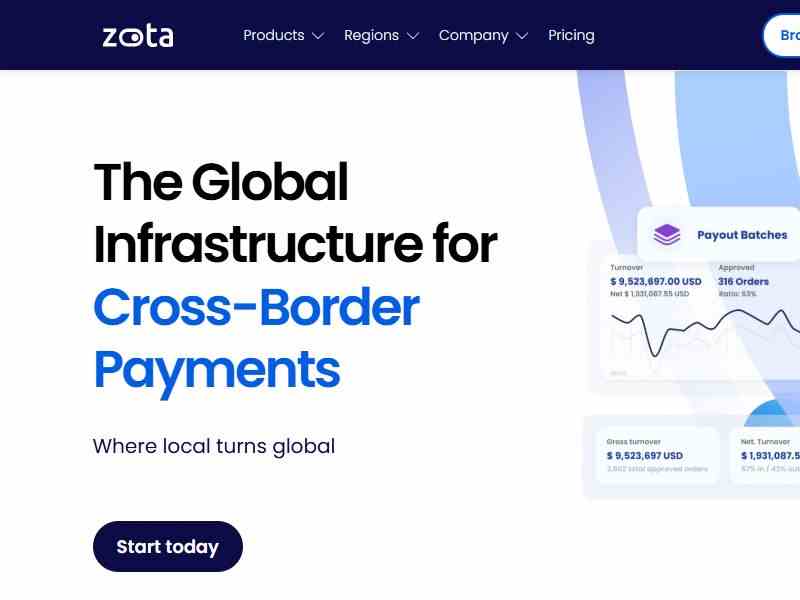
Image: Zota.
Connecting a local payment experience with global operations
Zota describes its offering as cross-border payment infrastructure and identifies financial services among the industries it serves. Its website organizes payment coverage by region and offers a country-level search. The presence of a region on that site is useful for initial discovery; it does not establish that every method, currency or service is available to every brokerage or customer.
In a multi-market business, a client may expect a familiar domestic payment method while the brokerage needs a consistent view of incoming transactions. The integration problem spans both sides: the client must understand the payment instructions and status, while operations must match the resulting transaction to the right customer account. A gateway can simplify the connection, but it does not remove the need to agree supported markets, eligibility and settlement terms.
Before rollout, a brokerage should request a current coverage schedule for the specific contracting entity and target countries. That schedule should distinguish deposit from payout availability, transaction and settlement currencies, processing hours, account requirements, limits and any restrictions on the business model. Marketing totals are not a substitute for a route-by-route assessment.
Metagate and the operations dashboard
Zota calls its gateway Metagate. Its product page describes a dashboard for daily activity and statistics, filters for selected periods and access to order histories. The accounting terminal is described as showing total and available balances as well as pending payouts, with reports for daily, weekly or monthly periods.
These views address different questions. A transaction record helps investigate a customer's specific payment; a balance report helps finance understand the funds available for settlement or disbursement. A brokerage should establish which identifiers appear in each view and how those records connect to its CRM, trading account and ledger. Matching the amount alone is insufficient when customers can initiate repeated payments for similar sums.
The vendor also describes user-account and permission management. That matters when finance, customer support and administrators need different levels of access. During a demonstration, teams can test whether a user who investigates a transaction has only the permissions appropriate to that role, and how changes to permissions are reviewed. The exact controls and audit evidence should be confirmed in the contracted configuration.
Payment pages and customer experience
Zota describes a customizable payment page that can reflect a merchant's logo, colours, background and payment flow. For a brokerage, branding is only one aspect of a deposit experience. Customers also need clear information about the chosen method, currency, next steps and status; support staff need enough context to answer questions without asking the customer to repeat the entire process.
Different local methods can have different completion patterns. A flow may redirect the customer to another interface, require an additional confirmation or produce a delayed status. The implementation should therefore define the states shown to the customer and the event that permits the brokerage to credit an account. A return to the merchant page, for example, should not automatically be interpreted as confirmation that funds are settled.
Acceptance testing should include a successful payment, customer cancellation, a rejected transaction and a status update that arrives later than expected. Teams should also agree how duplicate notifications and repeated customer attempts are handled. These are evaluation scenarios rather than claims about a particular Zota implementation.
Payouts, refunds and exception handling
Zota's Metagate page describes individual payouts, batch uploads and API or portal-based processing. It also describes individual and batch refunds, including partial amounts where supported. These are separate workflows: a payout transfers funds from the merchant balance to a recipient, while a refund relates to a prior payment. Availability and operational rules should be confirmed for each method and market.
For brokerage withdrawals, the operating design should specify who can initiate, approve and release a payout, what customer-account checks occur beforehand and how the result is reconciled. A batch can reduce repetitive work but also makes it important to identify individual rejected or pending items without resubmitting successful ones. If an API is used, the firm should test how retries are linked to the original request.
Zota says merchants can open service cases for missing deposits or payouts and monitor case status in the portal. An effective support procedure should connect the customer ticket, the merchant's internal transaction ID and the gateway record. It should also define escalation thresholds and the evidence required to investigate a delayed transaction with the relevant payment partner.
Risk controls and the role of each provider
Zota describes fraud-detection and risk-mitigation tools on its site. A payment risk signal can inform an investigation, but it does not replace a brokerage's own customer due diligence, transaction monitoring or approval responsibilities. Teams should ask which checks are performed by the gateway, which are performed by a downstream payment provider and which remain with the brokerage.
The company's gateway page refers to PCI-DSS and ISO 27001 in describing its payment-page security. A buyer should request current evidence, identify the certified entity and service scope, and assess its own obligations. Using a hosted payment page may change how card information is handled, but it does not automatically make every system or merchant compliant.
Access management deserves the same attention as the checkout. Finance users who can release funds, support staff who view customer records and developers who manage integration credentials may require different permissions. Contractual responsibilities, credential rotation, monitoring and incident notification should be documented and tested for the actual deployment.
Commercial terms and integration questions
Zota's website discusses multiple payment methods and currencies, but actual commercial terms depend on the arrangements agreed for the merchant. A meaningful comparison should include transaction fees, currency conversion, settlement timing, reserves or other deductions where applicable, as well as integration and support costs. An advertised payment method is not useful if the contracting entity, region or underlying business model is ineligible.
Technical assessment should cover both the customer-facing cashier and the operational records. The parties should agree request and notification formats, status definitions, reconciliation identifiers, retry behaviour, test cases and support ownership. For each route, the brokerage should know how to tell a pending payment from a failed one and how corrections are represented in its ledger.
| Workstream | Points to confirm |
|---|---|
| Market coverage | Eligible entities, countries, methods, currencies and limits |
| Deposits | Customer flow, status notifications and account-crediting rules |
| Payouts and refunds | Approval, individual and batch processing, retries and reconciliation |
| Risk and security | Provider responsibilities, access permissions and current evidence |
| Commercial terms | Fees, conversion, settlement timing and applicable reserves |
Where Zota fits for a brokerage
Zota's published proposition is most relevant when a business needs to coordinate local payment experiences with central reporting and operational workflows. The cashier, Metagate reporting, payouts and support cases can be assessed as connected parts of the same payment journey, rather than as isolated features.
A useful pilot should follow a small set of representative deposits and withdrawals from the customer interface through status updates, accounting records and support resolution. The objective is to verify the exact routes and responsibilities available to the brokerage, including failure scenarios, before expanding into additional markets.
 Subscribe Now