


CurrentDesk Forex CRM: Back Office, IB Management and Broker Integrations
CurrentDesk brings customer relationship management, back-office administration and client-facing services into a shared operating environment for forex and OTC brokers. Its relevance to a brokerage extends beyond organizing sales contacts: the published product scope connects onboarding, trading-account administration, deposits and withdrawals, introducing-broker relationships and management reporting. For an operator comparing forex CRM providers, the central question is how those functions exchange information across the entire client lifecycle.
Fazzaco lists CurrentDesk under Forex CRM Provider and Forex Risk Management. This profile examines its published workflow and integration capabilities from a B2B procurement perspective. Official product pages were checked on October 12, 2026. Product descriptions below reflect CurrentDesk’s documentation; the implementation examples and acceptance criteria are editorial analysis, rather than results of an independent software test.
Where CurrentDesk fits in a brokerage technology stack
A broker typically needs several systems to serve one client: a website captures the initial inquiry, a CRM assigns the lead, identity verification supports onboarding, a trading platform maintains trading activity, and payment infrastructure moves funds. CurrentDesk’s forex CRM offering places the CRM, back office and trader portal within a unified product. That gives procurement teams a concrete architecture to assess: which records share one identifier, which events move automatically, and which processes still require an external service.
The practical value lies in continuity between departments. Sales should be able to hand a qualified prospect to onboarding without recreating the record; operations should be able to review account and payment information without relying on a salesperson’s notes. A useful demonstration therefore follows one customer through registration, verification, account creation, funding and support. Showing each module separately is less informative than showing whether the same customer record remains consistent throughout that journey.
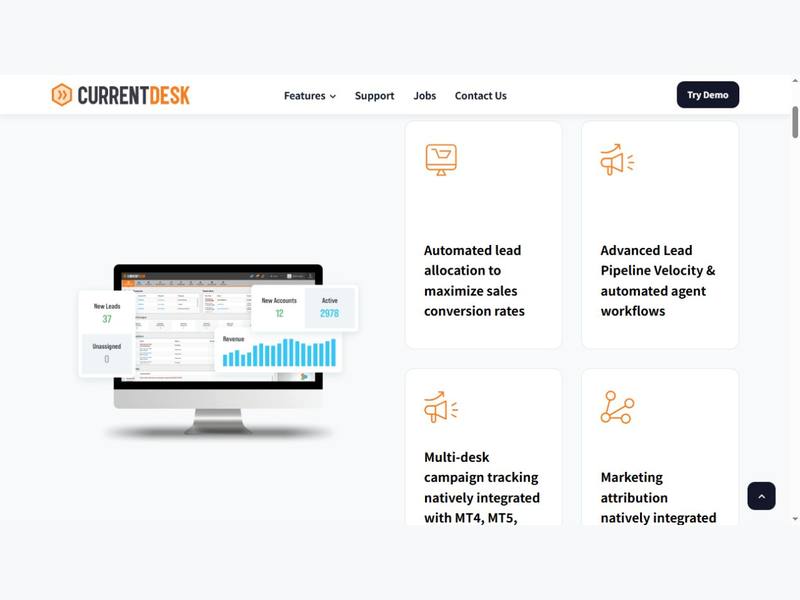
CurrentDesk’s official CRM product illustration, captured October 12, 2026. Displayed figures are vendor demonstration data.
Lead routing and attribution connect acquisition with operations
CurrentDesk describes lead distribution based on country, language and acquisition channel, alongside marketing attribution. These capabilities matter when a brokerage has several regional teams, language desks or affiliate campaigns. Assignment rules can give each incoming inquiry a clear owner, while attribution provides context on how the relationship began.
For example, a French-speaking prospect arriving from a partner campaign might need a particular sales team and an identifiable referral source. A broker evaluating the workflow should trace both pieces of information through subsequent registration and funding. It should also test what happens when a lead is reassigned, merges with an existing customer record, or returns through a different campaign. The purpose is to establish a reliable operational record, rather than assuming that a campaign label alone provides complete revenue attribution.
Management can then evaluate acquisition channels against defined stages such as completed registration, verified account or first funding. Those definitions should be agreed internally before configuring reports; otherwise two teams can use the same CRM data to produce different conversion figures.
The back office connects client records, KYC and servicing
The CurrentDesk back-office description covers client balances, transaction history, reporting, KYC documents and support. Its broader integration materials also identify identity-verification connections including SumSub and iDenfy. This separates two related responsibilities: maintaining the broker’s client record and obtaining verification results from the selected provider.
An onboarding demonstration should show the whole exception path, including an incomplete submission, a request for additional documents and a case awaiting manual review. The broker needs to know where staff see the current status, which team owns the next action and how a revised decision affects access to account functions. Built-in KYC workflows or an external verification integration do not, by themselves, establish that a broker has met every jurisdiction’s obligations.
Client support adds another operational consideration. If staff can see relevant account history alongside a support request, they have more context for investigating a funding or account-access query. Access should still be mapped to each role, so a customer-service user receives the information needed for the task without automatically receiving every administrative permission.
IB and affiliate management requires an auditable commission model
CurrentDesk describes a partner portal for introducing brokers and affiliate managers, referral tracking and multilevel commissions. Its published back-office scope includes rebates by account group, allocation across multiple partners and an allocation tree. These are meaningful distinctions for brokerages whose distribution network involves more than a single referrer receiving one flat payment.
The business model should be translated into worked examples before configuration. Consider a client associated with a primary IB and an upstream partner: the broker should specify the applicable account group, eligible activity, split and reporting period. It can then compare the expected allocation with the system’s calculation and the amounts shown to each partner.
Changes deserve separate testing. A client may move account groups, a partner agreement may change, or activity may require correction. The acceptance test should establish how effective dates and adjustments are handled, and whether finance can reconcile the final payable amounts. The published feature list establishes the intended commission scope; the broker’s own examples establish whether its particular commercial terms are supported.
Trading-account controls and managed-account connections
CurrentDesk’s back-office materials describe configurable leverage and internal transfers, as well as managed-account arrangements through MT4 MAM and an external Goldi solution for MT5. Its integration directory also lists CBMAM/Goldi and Brokeree copy-trading connections. These should be evaluated as distinct product relationships, with the relevant trading platform and external component identified for each workflow.
For an operations team, a leverage change is more than an editable field. The requested value must reach the correct trading account, the permitted staff member must authorize it, and the recorded result should match the platform state. An internal-transfer test similarly needs to follow both sides of the movement and the customer-facing history, including a rejected or interrupted attempt.
Managed accounts and copy trading add further boundaries between CRM records and trading infrastructure. A broker should ask which component owns allocation, which supplies reporting and which provider handles incidents. Listing an integration does not mean every configuration is included in a standard CRM agreement.
Platform integration: examine the documented connection in detail
The official integration directory describes bidirectional MT4 connectivity across multiple servers, including account creation, balance information, trades and rebates. MT5 is also listed. For a broker managing several environments, the ability to connect them is only the starting point: account identifiers, server selection, update timing and reconciliation must also remain clear to staff.
CurrentDesk’s public descriptions of cTrader require a specific confirmation. Its CRM page presents cTrader alongside native platform connections, while parts of the integration page describe cTrader connectivity as full and other text or FAQ material describes it as upcoming. These statements do not establish one unambiguous deployment status. A prospective buyer should obtain written confirmation of the currently available connector, supported version and functions for its intended configuration.
For every selected platform, test account creation and updates in both directions, followed by a temporary connection interruption and recovery. The demonstration should show how incomplete updates are identified and resolved, without assuming that a displayed balance and a trading-platform balance always update at exactly the same moment.
Payments, communications and data services have different roles
CurrentDesk lists payment connections including Skrill, Neteller, Nuvei and ZotaPay, as well as the Praxis payment gateway. A broker should distinguish a listed technical connection from its own commercial eligibility to use the corresponding payment service. Available countries, currencies, processing terms and settlement arrangements need confirmation with the relevant provider and contracting entity.
Operationally, the valuable test is an end-to-end funding record. Follow a payment from initiation through its recorded status and account effect, then test an unsuccessful or duplicated event. Finance should be able to explain the relationship between a payment-provider reference, a CRM transaction and the resulting trading-account entry. Withdrawal workflows deserve the same attention to status, authorization and reconciliation.
The directory also identifies Twilio SendGrid and Click to Call, plus CurrencyLayer and OpenExchangeRates. These integrations serve different purposes: client communication, telephone activity and exchange-rate data. Evaluating them separately helps clarify licensing, configuration, data ownership and the behavior of each workflow if an external service becomes unavailable.
Implementation should start with a defined operating model
A productive implementation begins with a map of the brokerage’s existing processes: lead ownership, onboarding states, account groups, partner agreements, payment routes, permissions and reporting responsibilities. That map gives both the broker and CurrentDesk a shared basis for deciding what can use standard configuration and what requires additional work.
CurrentDesk states that customization requests are reviewed and that fees may apply. Procurement teams should therefore document the requested outcome, dependencies, acceptance conditions and responsibility for maintenance before treating a requested change as part of the agreed service. A sales demonstration of a feature and a commitment to deliver a customized workflow are different pieces of evidence.
Data migration also needs its own scope. The broker should identify which historical records must remain operational, how duplicate customers and partner links will be handled, and how the migrated balances and histories will be checked. Security and service commitments should be assessed from the applicable technical and contractual documentation; a marketing badge alone is insufficient evidence of a particular certification or compliance guarantee.
A practical acceptance plan for brokerage buyers
The strongest evaluation uses the broker’s own operating examples across departments. The following tests connect CurrentDesk’s published product scope to observable outcomes without presuming that a feature list answers every implementation question.
| Workflow | Demonstration to request | Evidence to retain |
|---|---|---|
| Acquisition and onboarding | Route a multilingual partner lead, complete verification and open its trading account. | Ownership, referral source and status remain traceable across the client record. |
| Trading-platform connection | Create and update an account, interrupt connectivity, then recover synchronization. | Confirmed connector scope, matching records and a documented exception process. |
| Partner commissions | Calculate a multilevel split and apply an agreed adjustment. | Expected-versus-actual allocation and finance reconciliation. |
| Payments and transfers | Process successful, failed and repeated events; examine both sides of a transfer. | Consistent references, account effects and status histories. |
| Permissions and migration | Use separate staff roles and reconcile a representative migrated dataset. | Approved access boundaries and signed-off migration results. |
CurrentDesk’s published offering makes it relevant to brokers seeking a connected CRM, back office and client portal with partner and platform integrations. The procurement decision should turn on the fit between those capabilities and the brokerage’s actual workflows. A demonstrated client lifecycle, reconciled financial records and explicit integration commitments provide a firmer basis for that decision than broad claims about the number of features available.
 Subscribe Now

