


Exclusive Talk with Vyacheslav Zholudev, Co-Founder & CTO at Sumsub: How Far Can We Trust AI?
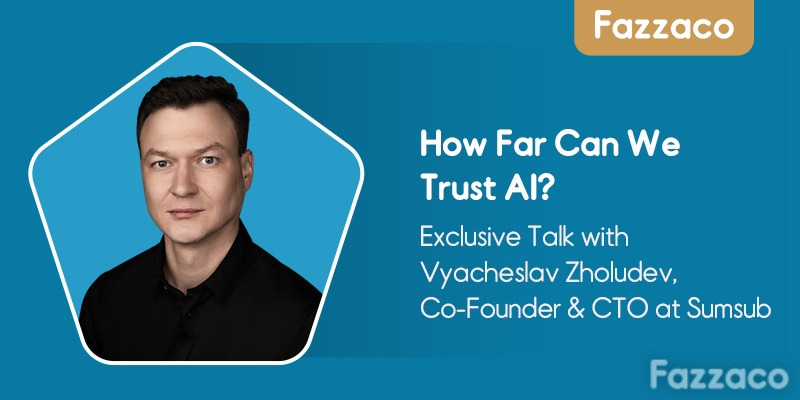
A few months ago, Fazzaco had the privilege of having an exclusive in-depth conversation with Vyacheslav Zholudev, the co-founder and CTO of Sumsub, a leading verification platform. This interview was a vital supplement to the topic of the impact of generative artificial intelligence, a field that is still hot and increasingly crowded, on the financial industry.
As the co-founder and CTO at Sumsub, Vyacheslav Zholudev brings unparalleled technical and entrepreneurial acumen to help Sumsub's development team reach complex goals effectively. Vyacheslav holds a Ph.D. in Computer Science from Jacobs University (Germany), with experience working as a solution architect at ResearchGate. He is an expert in privacy protection, ID verification trends, cases of digital frauds and international regulatory compliance regarding personal data.
Fazzaco: What are the implications of ChatGPT on the fintech sector? What are the opportunities/values and challenges it brings?
Vyacheslav Zholudev: Numerous considerations arise in the realm of fintech innovation. The innovation behind ChatGPT that has everyone excited is the fact that it makes very technical tasks open to the general public. Before, there was a high threshold for creating, developing, and coding apps and software. The promise of ChatGPT is that it can essentially create, develop, and code for you, instead of demanding that users possess these skills themselves. To take app creation as a recent example, ChatGPT-4 puts programming languages for app creation at your fingertips. Now, the only requirement on the user is an idea, not the technical know-how. This is a revolutionary development, and it puts a team of technical resources at your disposal to execute your vision. This is seen as an overwhelmingly positive development, since it allows more people to participate in the creation of advanced technologies without needing the technical expertise.
But the potential threat may lie for those who are tempted to use ChatGPT for investment recommendations. Despite their potential value, they carry inherent risk. As ChatGPT may produce content that is imprecise or even deceptive, individuals may face unintended negative consequences. Additionally, it must be noted that ChatGPT's training data is limited, having only encompassed information up through September 2021. Consequently, any guidance proffered by the technology may lack contemporary applicability.
Fazzaco: Where to use generative AI technology for fintechs?
Vyacheslav Zholudev: The implementation of generative AI technology in fintech companies has grown rapidly in recent years. However, it is crucial to identify its specific applications to optimize its efficiency while avoiding potential negative impacts. While the potential for this technology has been widely recognized, its use for certain areas should be avoided. For instance, it is not suitable for compliance purposes, especially when operating within a heavily regulated industry such as finance. This is due to the potential risks of errors and lack of transparency, which can impact regulatory compliance and potentially lead to legal implications.
Another area where generative AI technology should not be solely relied upon is in finance advising. In this regard, the human element remains essential as personalized advice that considers individual circumstances is necessary. Over-dependence on AI-generated suggestions could cause harm to clients instead of benefiting them.
Moreover, generative AI technology should not be completely relied upon for data extraction. Making firm conclusions based solely on AI-generated recommendations is risky and may lead to falsified claims. Though AI has the potential to streamline processes, its use must be approached with caution to ensure that conclusions or decisions are informed with a high degree of accuracy.
Fazzaco: What are the advantages of leveraging the AI technology to provide clients with investment advice or market insights and predictions over real financial experts?
Vyacheslav Zholudev: The use of AI technology in the provision of investment advice and market insights has become increasingly popular. However, it is essential to acknowledge both the advantages and limitations of leveraging this technology over engaging with real financial experts (I already touched upon it in the answer to the first question as well).
While AI technology may not be suitable for direct market predictions, it can be leveraged to analyze and summarize lengthy documentation. For example, financial reports from companies can be synthesized to gain better insights into their operations, providing a starting point for experienced investors to make independent investment decisions.
Nonetheless, AI-generated insights may not fully replace the expertise and intuition of a financial expert. It is necessary to note that AI-generated insights can be influenced by biases or limitations concerning available data. Therefore, any recommendations derived from AI must be scrutinized and informed by human expertise to mitigate risks and uncertainties.
Moreover, making investment insights more accessible through the use of AI may lead to an influx of investors without the required knowledge or experience required for successful trading. It is uncertain how the market would react to this upsurge, emphasizing the importance of human expertise in decision-making. While AI can support financial decision-making, it should be used with caution, acknowledging that its recommendations are only useful when complemented with human insight and judgement.
Fazzaco: From your part, what are the limitations ChatGPT have?
Vyacheslav Zholudev: First significant disadvantage of ChatGPT that comes to mind is the potential for hallucination. Chatbots may produce scarily convincing replies that may include false or inaccurate information, causing harm to clients unintentionally. Even with its sophisticated algorithms and powerful language generation abilities, ChatGPT still faces risks in providing accurate recommendations.
Secondly, ChatGPT's training data only goes up until September 2021, making it somewhat irrelevant to the changing landscape of the financial world. It is still uncertain how such limitations affect the platform's overall performance and adequacy for practical financial decision-making.
Fazzaco: JPMorgan Chase has restricted the use of ChatGPT by its staff over compliance concerns. What's your company's attitude towards the tech?
Vyacheslav Zholudev: Indeed, sending sensitive data to ChatGPT might not be a good idea, given the recent data leaks, which led to an increase in security breaches. We aim to utilize the AI technology for non-sensitive information alone, such as market insights, competitor analysis, and primary search, to minimize risks of cyber threats. This approach ensures that ChatGPT's potential is maximized without exposing financial or sensitive data to threats. By taking extra caution when dealing with sensitive data, fintech companies can significantly reduce the risks of damaging leaks and data breaches, ensuring that their clients' data remains confidential and secure.
Fazzaco: How far can you trust AI/ChatGPT?
Vyacheslav Zholudev: Although AI and ChatGPT are powerful tools in various industries, it is essential to remain skeptical about the results that they produce. When uncertain, reformulate or extend the question to gauge the reliability and consistency of ChatGPT's responses. Ideally, one should not make crucial decisions based solely on ChatGPT's response.
Instead, I would say one should consider it as an inspiration source and develop intuition about the matter at hand. Ultimately, human involvement and analysis are essential when making important decisions concerning finance, and the use of AI technology must be approached with caution to maximize its potential safely.
Fazzaco: Some experts hold the view that regulation lag behind the potential risks posed by ChatGPT. Some countries, such as US, have called for regulation of AI technology to ensure it does not hurt growth or become a national security risk. What does ChatGPT's future hold in your view?
Vyacheslav Zholudev: The future of ChatGPT raises concerns for many people. Apart from concerns over job loss and global economic impact, there are alarming implications related to the use of ChatGPT in our field. If ChatGPT learns to work with images, it could easily be used to create fraudulent documents and deep fakes that are currently used in the KYC onboarding process. As a result, the current methods for safe user onboarding may no longer be enough. This could lead to a significant transformation in the identity verification industry or even a return to traditional methods where people physically visit an office to open a bank account.
The pace and speed of what these AI tools unlock, including ChatGPT but also others, immediately calls for further investigation into its potential negative capabilities. Tech industry leaders and notable computer scientists published an open letter advocating a halt on further development of ChatGPT beyond its latest publically available version, Chat-GPT4, over the same concerns. If these technologies are to continue, they will need a series of regulatory and legal guardrails to guide their development in a controlled manner.
Further, Europol recently warned that they have already seen fraudsters harnessing Chat-GPT for their schemes, adding that, "For a potential criminal with little technical knowledge, this is an invaluable resource. At the same time, a more advanced user can exploit these improved capabilities to further refine or even automate sophisticated cybercriminal modi operandi.
The UK government put out a proposal framework regarding rules and regulations for AI technology, specifically around “risks it could pose to people's privacy, human rights or safety” and we expect other governments to follow suit. A series of safeguards that do not prevent AI technology innovation must be adopted quickly to protect all parties involved.
Read more
Fazzaco AI Forum: Voices from Brokerages and Fintech Leaders - When Finance Meets ChatGPT
Listen to the Article: #ChatGPT, How Will It Revolutionize Finance?
Andrey Sever, Co-founder & CEO at Sumsub: Staying Ahead of Fraudsters with KYC Processes
 Subscribe Now