


Legal Cases and Beyond: Disputes Between IS Prime, Think Markets, and ISFE 21 (PART III)
While we are waiting for the updates of Think's counterclaim against IS Prime, we found some interesting facts about the two parties.
Debate on LinkedIn
Another intriguing thing we found was that in December 2020 when the first summary judgment was released, an argument was aired publicly on LinkedIn regarding the trades execution method, where IS Prime happened to be an important participant. The whole argument focused on RTS 28 report and why IS Prime's report was different from industry peers.
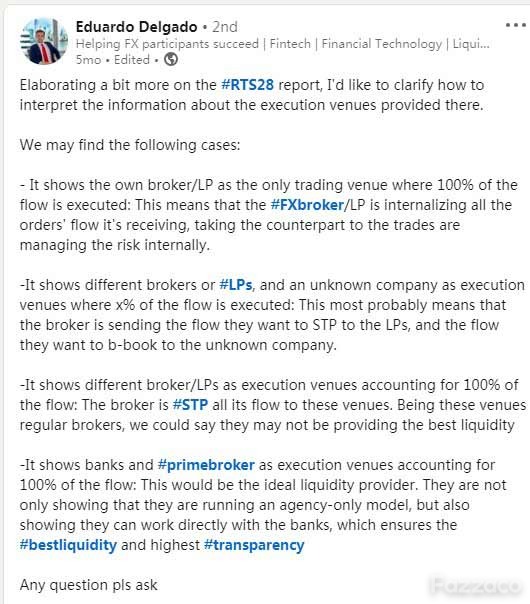
The uproar was then triggered when Yuriy Maevskiy, a senior forex project manager in Cyprus, asked about IS Prime RTS 28 report.
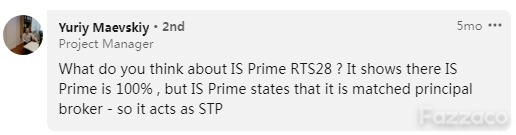
This sparked an unparalleled fight among prominent figures in the B2B forex industry, including leaders from IS Prime, Advanced Markets & Fortex, and IVAST Global, who all engaged vigorously in expressing their interpretation on RTS28 and whether the regulatory body's effort would be all in vain.
Jonathan Brewer, Managing Partner at IS Prime claimed that it is in deed a matched principal broker, and all trades are conducted with clients as principal. "The reason why IS Prime's RTS28 report shows 100% IS Prime is for exactly this reason. IS Prime faces clients as (matched) principal, and as such, all of IS Prime's client trades are executed as principal with IS Prime. With respect, our interpretation of the RTS28 report is somewhat different to Mr. Delgado's."
Later, Robert Buxton, Sales Director at IS Prime added "when trading with an FCA regulated IFPRU 125k matched principal broker, the client's counterparty on all trades is the broker itself and not the underlying LPs. This therefore means that 100% of client are orders are executed with the broker, which is what should be shown on the report."
Although Mr. Maevskiy thought "t makes sense-in all brokers agreements it is written that the broker is a final counterparty to the clients trades," Natallia Hunik, Chief Revenue Officer at Advanced Markets & Fortex interpreted RTS28 in a different way.
She claimed that "the way IS Prime does is misleading and in fact defeats the point of the report, which is providing transparency to the investors.”
The fight then started to escalate, and became more fierce after Gavin White, CEO at Australia's INVAST Global waded into the debate in favor of Ms Hunik's opinion.
"What's so scary about being totally open and honest about where you hedge and where you don't. Clients of INVAST Global see pre-trade and post trade exactly which LP we are hedging their trade with. No tricks. No smoke and mirrors.”
"IS Prime is indeed a matched principal broker, and as such, all trades are conducted with clients as principal (and then simultaneously hedged, also as principal) and then simultaneously hedged, also as principal. Hmmm – really??? Simultaneously? Do you attest to that? Because under your license, aren't you obliged to do exactly that? So – you simultaneously hedge all flow as a principal? But – Who do you hedge with? Obviously that is crucial because if you are hedging with another entity that you own, isn't that monumentally misleading clients and disingenuously interpreting regulations that are there to protect the interests of clients?" questioned Mr White.
The 2v1 situation changed when Angus Walker, General Manager at Global Prime, added his perspective by saying "In summary, RTS28 is useless and it's up to brokers and PoPs to utilize post-trade reporting and TCA to provide end users with actionable information and real transparency.”
"Having worked with IS Prime for several years, I was never disappointed with the level of detail in an execution report or transparency over how and where trades were executed. In other words, IS Prime did for a client what RTS28 couldn't. They provided the end user with meaningful information about how well they performed for 'their' trades. Warts and all." This was how Walker endorsed IS Prime.
"Lastly, brokers don't need a regulatory directive to compete on price, execution and transparency. We can be offended by the disparity around brokers disclosures in RTS28 or we can be better. I'd rather be in the camp focusing on the latter," added Mr Walker, trying to be neutral.
No agreement was achieved in the debate, but it did popularize what RTS 28 was and what risk hedging mean to forex brokers and liquidity providers. At the same time, many companies in the industry showed their dissatisfaction towards IS Prime for its lack of transparency in providing limpidity sources.
Let's compare IS Prime's RTS 28 report and others'.
The first one is Advanced Markets.
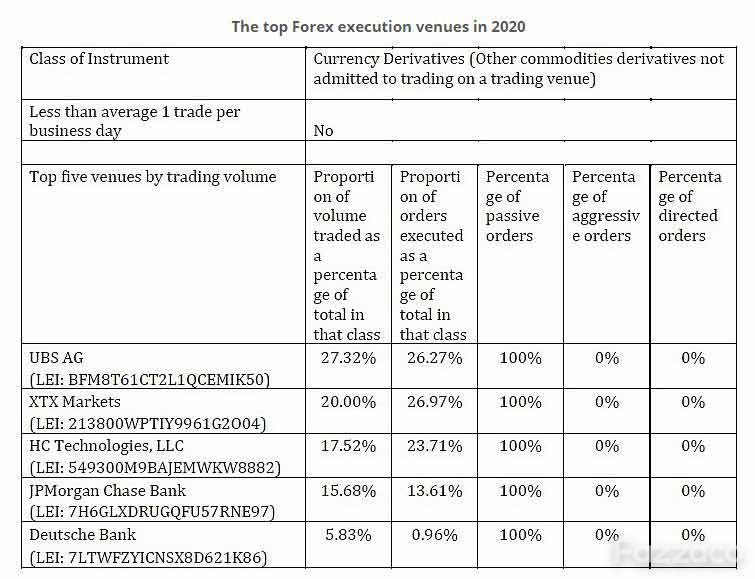
Then, let's check Equiti Capital.
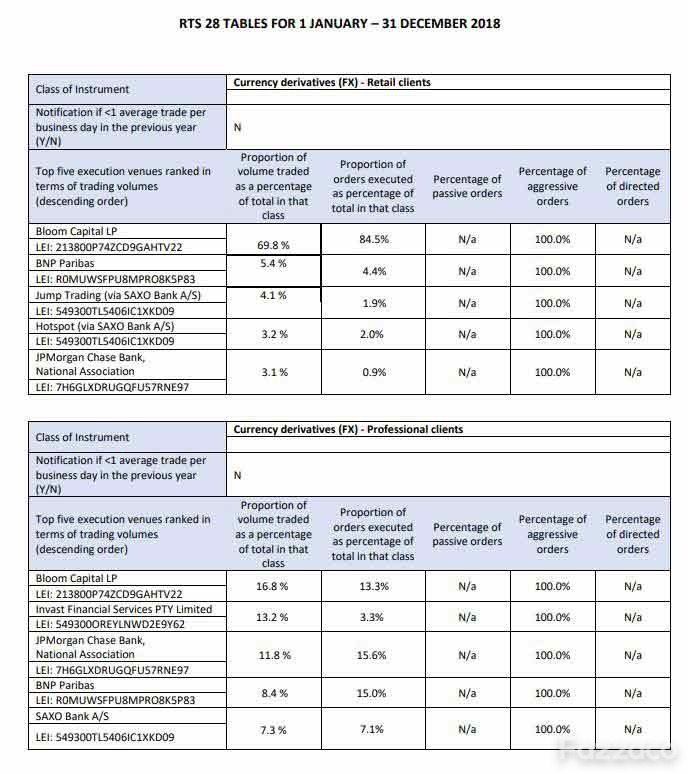
The third one is FXCM UK.
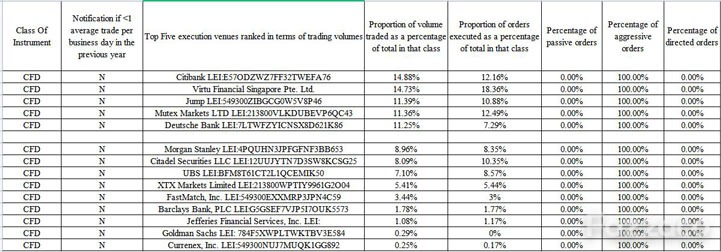
It can been learned that their TOP 5 venues include banks, mainly multi-national banks that are able to deal with multi assets. So how does IS Prime's report look like?
IS Prime stated that "it is the sole execution venue for all client orders. Client orders are therefore not traded through or on any trading venue or other external execution venue.”
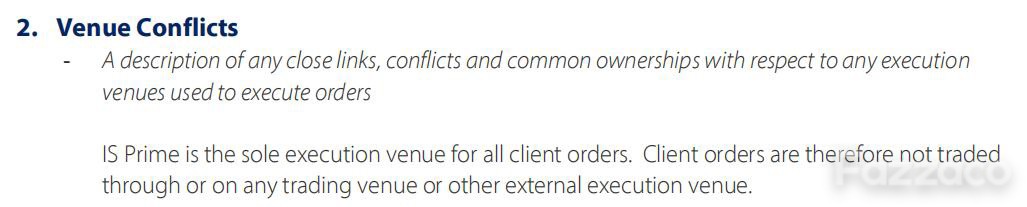
Combining above analysis, data and Eduardo's post, can we assume that IS Prime hedged all these trades internally?
IS Prime's Lawsuit Against Glassdoor
IS Prime seemed to be involved in another case other than Think Markets.
According to a summary judgment, IS Prime accused Glassdoor, a US-headquartered recruiting platform, and two users, of fabricating reviews that "are without foundation and . . . are demonstrably untrue" and that are "capable of causing and indeed likely to cause serious financial loss to IS Prime."
IS Prime believed that the Glassdoor reviews were posted by Siddiqui, of Think Markets, who "embarked upon a campaign to publicly harm IS Prime, and malign its reputation."
Now the court has ruled in favor of IS Prime who filed an ex parte application seeking permission to issue a subpoena to Glassdoor and the two users. The case is ongoing and we will keep track of it.
Some Thoughts and Questions
The judgment keeps going, and neither of the two sides is likely to drop the case. The case is of paramount importance in the forex B2B industry, particularly in the prime brokerage sector, as it raises several questions that worth thinking.
First, it's very common for a forex broker to use a hybrid model to reduce risks and seek higher profits, although many claim they are STP/ECN brokers. So what broker can count as a true purely A Book broker? Is there any in the market? In Think's case, does it suffer less loss in A Book or B Book?
Second, does IS Prime provide prices through ISFE 21 by adding "undisclosed margin and mark-up to trades" before sending the price to other retail brokers? How many spreads are added? What's the rebate?
Third, the forex B2B industry is not as transparent as B2C industry, especially in terms of liquidity provision since it contains so many tiers and brokers can deal with trades by dealing desk and non-dealing desk. How can a broker tell a liquidity provider's strength? Will other LPs follow suit after IS Prime and ISFE' 21s hidden transaction is revealed?
Fazzaco will keep track of the case. If you have any clues or information, please send it to news@fazzaco.com.
 Subscribe Now