


Legal Cases and Beyond: Disputes Between IS Prime, ThinkMarkets, and ISFE 21 (PART I)
Fazzaco learned that Judge Adrian Beltrami QC of the Business and Property Courts of England and Wales ruled in favor of ThinkMarkets in the counterclaim against IS Prime.
As early as in December 2020, a High Court judge refused to stay the suit after finding that the two sides had not agreed to solve the dispute in arbitration before pursing parallel legal claims.
In March 2022, Deputy Judge Richard Salter QC of the England and Wales High Court dismissed most of a $15 million lawsuit filed by IS Prime accusing three entities belonging to ThinkMarkets (i.e. TF Global Markets (UK), TF Global Markets (AUST), and Think Capital Limited) of violating an exclusivity agreement that controlled trade between IS Prime and Think Markets.
ThinkMarkets, in the counterclaim, sought "various heads of relief including rescission, damages and restitution, alleging, amongst other things, breach of contract, conspiracy and deceit." ThinkMarkets accused IS Prime of making profit through "secret and undisclosed margin, mark-up and spread capture from internalised trades received or retained by ISFE 21", an affiliated company, which caused a loss between $17,094,496 and $20,329,798 to ThinkMarkets.
So what's behind the long-running court case? How did IS Prime and ThinkMarkets involve in the dispute?
Timeline
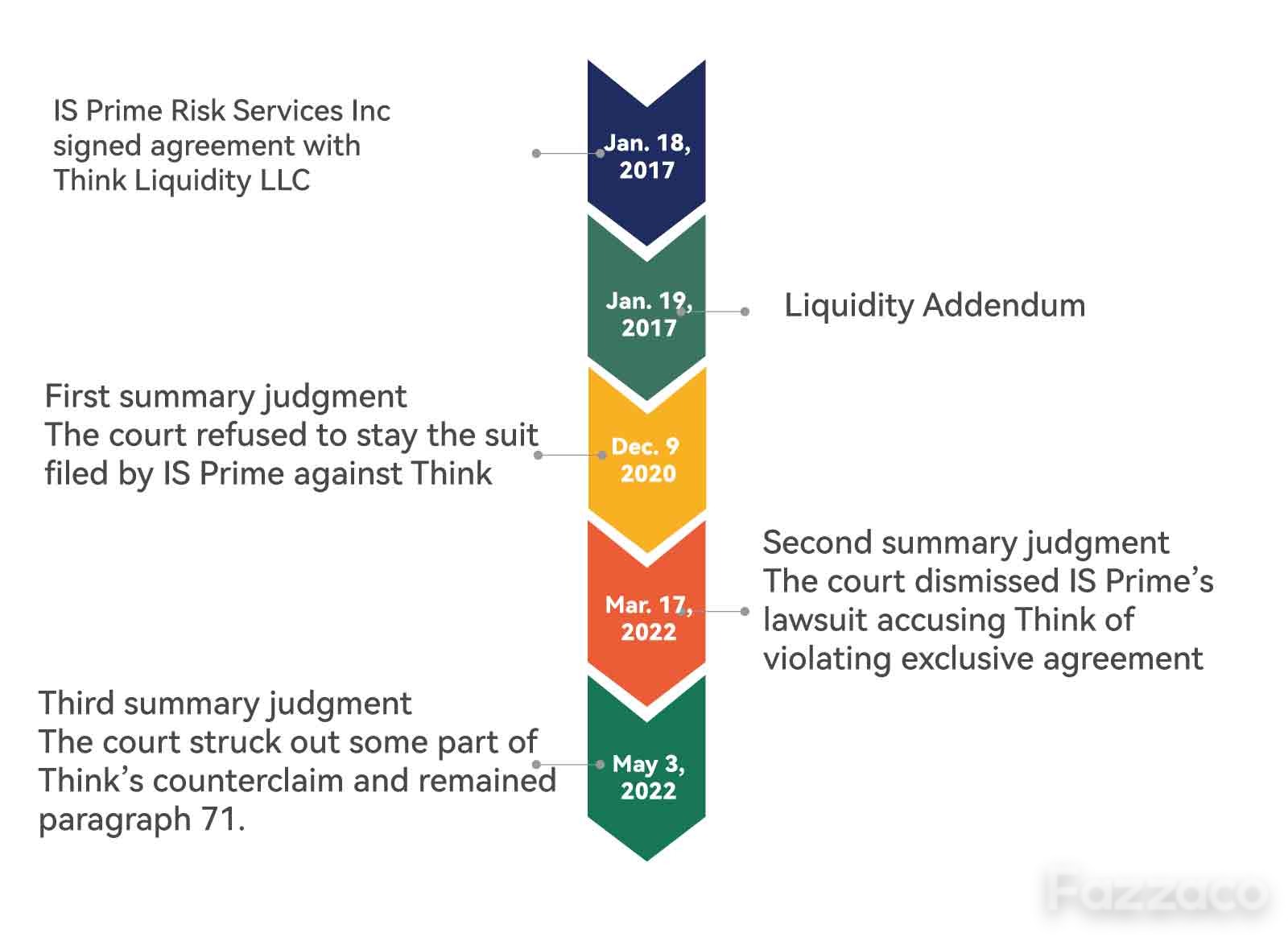
IS Prime Risk Services Inc, known as IS Risk Analytics Inc ("ISRA"), and Think Liquidity LLC ("Think") were companies incorporated in the State of Delaware, USA. By a sale and purchase agreement dated 18 January 2017 ("the Sale Agreement"), ISRA agreed to buy and Think agreed to sell certain business assets, including the domain name thinkliquidity.com and proprietary software related to it, software and content databases, customer email lists and databases, and intellectual property rights.
Interestingly, neither the claimant (IS Prime) nor any of the defendants (Think) was or is party to the Sale Agreement. However, the Sale Agreement contemplated that there would be contracts between them for the provision of services, and the claimant said contracts were concluded on the basis of its primary terms of business, FX terms of business and trading conditions for index swaps and spot FX, and an exclusivity agreement dated 19 January 2017 entitled "Liquidity Addendum". The claimant said that these were all governed by English law with provision for the courts of England and Wales to have jurisdiction (non-exclusively, in the case of the Liquidity Addendum). It was this Addendum that triggered the disputes between the two sides.
First Summary Judgment
The procedural chronology began with a letter before action dated 17 December 2018 from Sachs Sax Caplan ("Sachs"), Florida attorneys acting for the claimant and ISRA (and their affiliated entities), giving notice of inter alia the claimant's contention that the Liquidity Addendum had been breached and indicating that proceedings in the United States District Court for the Southern District of Florida would follow in short order if that contention was disputed.
In IS Prime's first claim, the claimant alleged that from about 18 September 2018, in breach of the Liquidity Addendum, the defendants used the services of another broker or brokers for business they were obliged to give exclusively to the claimant until 17 January 2020. The claimant said it suffered loss of US$15 million as a result.
Nevertheless, Mr Justice Andrew Baker refused to stay the suit and ruled in the first summary judgment:
"Section 7.7 provides that any dispute, controversy or claim between the parties to the Sale Agreement arising out of or relating to it 'shall first be submitted to non-binding arbitration' in Palm Beach County,...
I shall assume in the defendants' favour without deciding that the meaning and effect of the agreement between Think and ISRA... that any dispute between them arising out of or relating to the Sale Agreement shall first be submitted to non-binding arbitration..., which is a matter governed by Delaware law."
Second Summary Judgment
In the second summary judgment published in March 2022, the court axed IS Prime's lawsuit against Think. IS Prime alleged that Think breached the exclusivity terms of the Liquidity Addendum between 19 January 2017 and 19 January 2020 by using the services of other brokers, but the court found the exclusive agreement only controlled trade between IS Prime and Think, and did not restrict any transactions not specified in the terms.
Deputy Judge Mr. Richard Salter QC found that on 8 December, 2017, IS Prime sent to Think an email headed "Changes to ISAM Capital Markets Index Swap offering".
According to the court, the email indicated that IS Prime had transferred its index swap business to IS Prime Hong Kong, freeing Think to carry out those transactions with others.
Mr Al-Attar, who appeared for the Claimant, argued that index swaps nevertheless continued to be "offered" by IS Prime, in the sense that it was thereafter able, willing and prepared to arrange such transactions with IS Prime Hong Kong. The judge opposed Mr Al-attar's argument, stating "that was not something that was contemplated by the terms of the Liquidity Addendum. Such a change would have required the agreement of Think, which was not forthcoming."
"An offer of new terms is not of itself necessarily a repudiation of the old terms, nor (unless it is accepted) does it prevent those old terms from continuing," added Mr Richard Salter QC.
"In my judgment, a reasonable commercial party in the position of Think would have interpreted that as a statement that, from 18 December 2017, IS Prime would not itself trade that class of product. That is so, notwithstanding the accompanying request to Think to sign up to new terms with IS Prime and IS Prime Hong Kong. Any other interpretation would, in my view, fly in the face of commercial common sense,"the judge concluded.
What happed after the second summary judgment? How did ThinkMarkets fight back? The case continues.
 Subscribe Now