


Vela and Exegy: Market Data, Ticker Plant and Capture Replay
Vela became part of Exegy through the companies' 2021 merger, bringing its market data and execution technology into a broader trading infrastructure business. For brokers familiar with the Vela name, the current Exegy portfolio provides the relevant context: normalized real-time feeds, dedicated ticker plants, historical data capture and replay, and managed infrastructure supporting electronic trading applications.
These products sit behind the trading screen. They help firms acquire exchange data, turn different feed formats into usable application inputs, retain a record of market conditions and operate the infrastructure serving those workflows. The B2B buying discussion therefore concerns data quality, delivery, deployment and operational responsibility, alongside the latency requirements of the trading business.

Exegy official website: the company and its trading infrastructure business.
Vela's technology heritage within Exegy
Exegy's official history states that it merged with Vela Trading Systems LLC in 2021 with backing from Marlin Equity Partners. The combined company operates as Exegy, Inc. Vela's former website directs visitors to Exegy, establishing a visible connection between the historical brand and the current business.
Vela's earlier portfolio included a ticker plant, execution gateways, direct market access technology, risk tools and the Metro trading platform. Those historical categories explain why the company appears in trading software and market infrastructure directories. They should not be treated as a promise that every earlier product name, commercial package or integration remains unchanged in a current proposal.
Exegy's current positioning covers real-time and historical market data, trading signals and execution-related infrastructure for financial institutions. For a broker beginning a new project, the practical step is to identify the current product and delivery model serving its requirement. A historical supplier relationship and a new deployment can share technology heritage while requiring different documentation and operational arrangements.
Normalized market data connects venues to trading applications
The agency-broker solution describes an API through which applications subscribe to normalized real-time updates from more than 200 direct feeds. Exegy identifies smart order routers and execution algorithms as consumers of that information. It also describes aggregated pricing views, including National Best Bid and Offer calculations and virtual order books across selected markets.
Normalization addresses the application interface to market data. Venues can have different messages and structures; a common model helps application teams work with the information through a consistent interface. It does not make the underlying markets identical. Instrument definitions, trading sessions, depth and permissions still matter when a firm defines the feeds its applications need.
For an agency broker, this places data design close to execution design. An order-routing application needs information appropriate to the markets and instruments it serves. A useful scope starts with those requirements, then identifies feeds, delivery methods and the operational records needed to understand how the application behaves under changing conditions.
| Product or capability | Published purpose | Brokerage workflow |
|---|---|---|
| Exegy Ticker Plant | Hardware-accelerated processing of real-time market data | Supplying latency-sensitive applications |
| Axiom | Consolidated normalized market data feed | Accessing markets through a managed feed service |
| Capture Replay | Recording, timestamping and replaying market data | Testing, analysis and database loading |
| Hosted infrastructure | Dedicated appliances and feed connections in data centers | Deploying near the required trading infrastructure |
| Managed services | Monitoring, management and operational visibility | Coordinating service operation and support |
Exegy Ticker Plant offers dedicated processing infrastructure
The Exegy Ticker Plant, or XTP, uses field-programmable gate array technology for market data processing. The product is directed at firms running mission-critical, latency-sensitive applications and needing capacity as data volumes increase. Exegy also connects XTP with its Capture Replay product for high-capacity packet capture.
Its deployment options distinguish hosted and on-premises arrangements. In the hosted model, the provider supplies space, power and direct feed connections, with resilient appliance pairs described in the product materials. An on-premises installation instead uses the client's data center environment and existing connectivity, giving the firm control over implementation in its own infrastructure.
The distinction is operational as well as technical. A firm needs to establish where applications connect, which team owns each component and how capacity changes are coordinated. Choosing dedicated infrastructure should follow the workload and operating requirements, rather than treating hardware acceleration as a universal answer to every data problem.
Axiom provides a consolidated feed delivery route
Exegy's agency-broker page presents Axiom as a consolidated service delivering normalized market data across global markets. This offers another route into the portfolio alongside dedicated ticker-plant infrastructure. The choice concerns how a firm wants to obtain and consume its data, including its internal resources and the role of managed services.
A consolidated feed can be relevant when an organization wants a common external data service for several applications. A dedicated installation can be relevant when it needs a particular infrastructure configuration. These are scoping considerations, rather than assumptions that one option is necessarily faster or more economical for every deployment.
Coverage should be defined at the feed and application level. A list of markets is useful, but procurement also needs to know the delivery format, permitted use and required level of detail. Aligning those items with the consuming applications helps avoid a mismatch between the service purchased and the data that developers or trading teams expect.
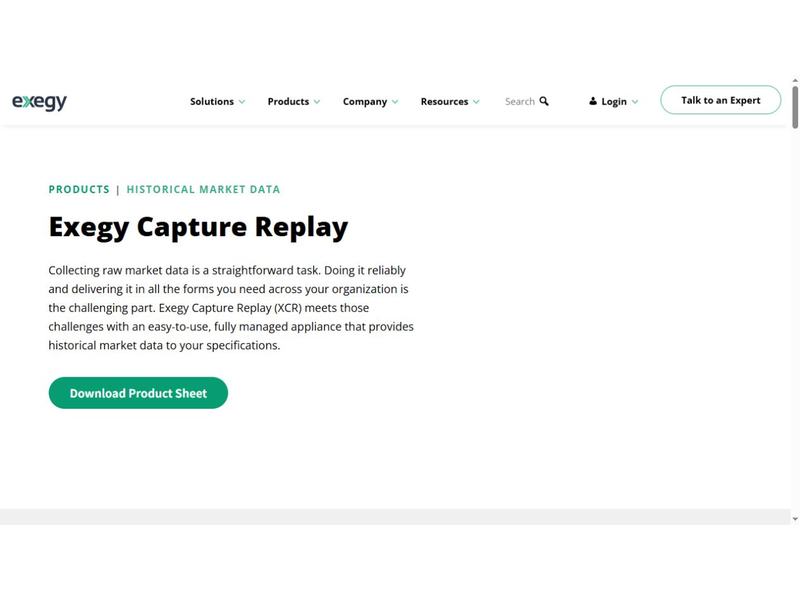
Exegy official website: the Capture Replay product.
Capture Replay preserves data for testing and analysis
Exegy Capture Replay, or XCR, is a managed appliance for historical market data. The product captures packets and combines recording with a ticker-plant function, allowing data to be delivered in different forms. Raw-data users receive PCAP files with nanosecond-precision timestamps, while applications needing normalized data can use structured or customized replay through the Exegy Client API.
That distinction matters because raw capture and application-ready data serve different purposes. An engineering team investigating a feed event may need packets, while an application test may need normalized messages delivered through an interface. XCR's published proposition covers both, allowing historical conditions to be used in performance and stability work.
The product also describes scaled replay and loading into tick databases, including vendor systems or internal databases. The operating objective is to separate database ingestion from unpredictable live data rates. For a broker, this connects market data infrastructure with the longer-lived record used by research, engineering and operational analysis teams.
Historical data supports several distinct internal workflows
Exegy identifies strategy testing, execution analysis, database loading and cloud storage among XCR use cases. It describes recording data in raw PCAP form and automating transfer to AWS, Google Cloud Platform or a firm's preferred infrastructure. Hosted XCR also includes the selected direct feed connections and ongoing monitoring.
These workflows need different acceptance criteria. Backtesting needs an appropriate historical sample and clearly defined replay conditions. Capacity testing needs a workload that exposes application behavior under higher rates. An operational investigation may need a precise time window and the ability to relate recorded market conditions to the firm's own events.
A recorded feed alone does not establish how a particular trading strategy would have executed or prove a regulatory outcome. The application, order records and analysis method remain part of that work. Treating capture as an evidence input helps teams use it productively without confusing data availability with a completed execution or compliance assessment.
Managed services define how infrastructure is operated
XTP materials describe continuous monitoring and management, a co-management toolkit and an on-demand web portal providing visibility into the solution. The hosted model lets a client connect locally to dedicated infrastructure in the same data center. XCR similarly describes provider-managed deployment and operation.
For a broker, outsourcing infrastructure tasks changes how responsibilities are coordinated. Internal application teams still need a clear relationship with the external service: which events are monitored, how incidents are communicated and who authorizes configuration changes. Operational visibility is useful because it gives staff a way to distinguish application behavior from an upstream data or infrastructure issue.
A service scope should therefore include the operational interface as well as the data interface. Feed changes, capacity reviews, support contacts and recovery procedures affect the daily experience of using the product. Defining them alongside deployment architecture gives procurement and engineering a common understanding of the service being commissioned.
Planning a deployment around the data lifecycle
Exegy's published implementation process begins with consultation and requirements, then moves through vendor planning, solution review, rollout and contract arrangements. It specifically identifies the choice of feeds and delivery method as part of requirements definition. This is a useful structure for a project spanning live data, recorded history and several consuming applications.
A representative workflow can start with a selected feed, follow normalized updates into an application, then retain and replay a market interval for analysis. Following that path reveals the connections between permissions, storage, interfaces and support responsibilities. It also gives teams a concrete basis for testing the proposed configuration before relying on it in production.
Vela's place within Exegy is consequently relevant to brokers looking beyond a standalone trading interface. The current portfolio connects real-time data processing with historical capture and managed operation. The substantive evaluation is how those components support the firm's applications and operational requirements, with current product scope established for the actual deployment.
 Subscribe Now

