


Brokers Personnel Moves 2022: Talents Gather in MENA, "She-Power" Needs to Be Taken Seriously
The year 2022 sees remarkable changes across the global forex markets. Many forex brokers are facing fierce competition in an increasing regulated environment and the trend of growing numbers of investors pouring into the the crypto world. To meet the needs of the market and fulfill their business goal, brokers have recruited or promoted some outstanding talents to strengthen their leadership teams.
Fazzaco keeps a close eye on developments in the forex markets and the movements of brokers. We analyzed 62 key personnel changes at 42 leading brokers in 2022, with the hope that it will provide some insight into where brokers are possibly headed and and their preference in talent appointments.
Talents Gather in the MENA Region
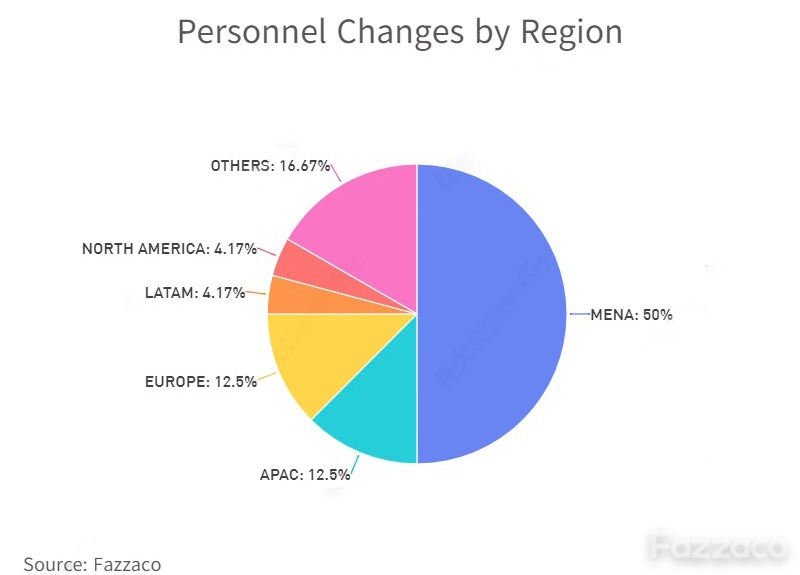
Among the 62 personnel changes selected in 2022 by Fazzaco, 24 new leaders have been appointed to take charge of regional affairs. From the perspective of regional distribution, the MENA (Middle East and North Africa) region has gathered the most new leaders, with 12 people, accounting for 50% of the total number of new regional leaders, followed by the Asia-Pacific (APAC) and European regions, with 3 personnel changes each, accounting for 12.5% respectively. It can be seen that brokers attach great importance to the development of the MENA region this year.
For example, Admirals, the global retail FX and CFDs broker, appointed Sami Hamed, who has over 25 years of experience in the financial services industry, as the new Chief Executive Officer of its branch in Jordan in March. Also, the world's leading multi-licensed broker CAPEX.com named Abdelhadi Laabi, who has more than a decade of prolific experience in marketing and branding, as its Chief Marketing Officer for the MENA region, responsible for further expanding the company's brand name and vision in the region.
Sales May Be the Biggest Winners at Brokers
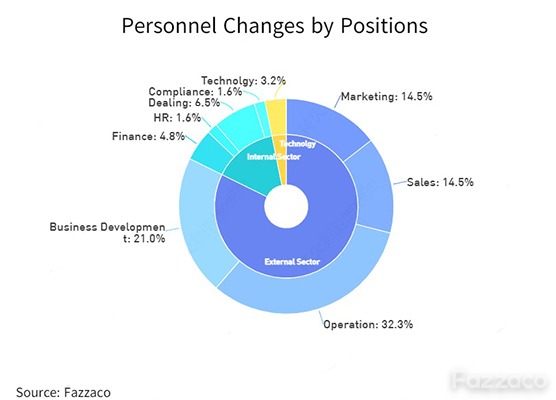
Based on our analysis of brokers in the industry, Fazzaco believes that positions in the forex brokers can be roughly divided into three categories: technolgy, external sector (including marketing, sales, operations and business development), and internal sector (including HR, compliance, finance and dealing). As the data showed, more than 80% of the selected 62 broker personnel changes occurred in the external sector. Among this department, the new leaders who are responsible for companies' operation and business development are the most, with 20 and 13 respectively, accounting for 32.3% and 21.0%. Marketing and sales leaders followed with 9 each, accounting for 14.5% respectively.
It is worth noting that, among the 33 leaders who are in charge of operation and business development of companies, 12 out of 23 have extensive sales experience, excluding the 10 people who have been working on this position for a long time.
Sales is the cornerstone of the development of any broker, and without it, there is no business. Excellent sales staff have access to first-hand information and feedback from clients when developing and maintaining their customer relationship networks, as well as being the first to see changes in market trends and customer intentions, which are critical for brokers to further develop their business.
Thus, it can be seen that the sales specialists may be the most likely to be promoted to take on key management leadership roles in a brokerage.
Women Remains Dramatically Underrepresented, Ratio of Men to Women Closes to 3:1
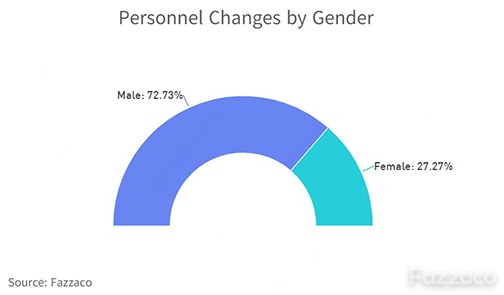
According to the statistics, only 17 of the 62 new leaders were female and the ratio of male and female was close to an astonishing 3:1. Among them, Riana Chaili, a financial expert with extensive experience in FX dealing operations and risk management, had been appointed as New CEO for EMEA at Invast Global, a leading multi-asset broker, in May this year. Notably, Riana is the first-ever female executive at the nearly 10-year-old brokerage, and the only woman in the firm's current top leadership team (7 people in total). OANDA, the global leader in online multi-asset trading services, also appointed Jessica Beckstead, a female veteran with nearly 20 years of experience in the industry, as its North American Managing Director and US CEO in September.
Previously, McKinsey and LeanIn.Org had also analyzed the data of women in the North American financial industry in 2021, and came to a similar conclusion, that is, women in North America remained dramatically underrepresented in the financial-services workforce—particularly at the level of senior management and above. The industry-specific analysis revealed a leaky pipeline from which women are falling out in greater numbers as they progress up the career ladder, resulting in significant inequality at the top.
At the beginning of 2021, the representation of women in the financial-services workforce had increased across all ranks above entry level, compared with 2018. While women have a slight edge at the entry level (comprising 52% of the industry workforce), their representation falls off at every step of the corporate pipeline. From the entry level to the C-suite, the proportion of women fell by 48%, and they accounted for only 27% in the top class. Consistent with previous years, women in financial services continue to experience a "broken rung" at the first step from entry level to manager—where they are significantly less likely than men to be promoted.
Fazzaco previously introduced some new female leaders in the first half of the year, showcasing the "she power" of the financial world. They are excellent, and there should be more such excellent women joining the financial world. According to a study released by the World Economic Forum in 2018, having more women in financial firms is associated with greater stability, better resilience, improved risk management, and better relationships with customers. At the same time, women leaders have also taken on the additional responsibilities of supporting employees and investing in diversity and inclusion during the COVID-19 pandemic.
Obviously, the financial industry needs to do more to address the severe gender imbalance in the industry and do what it can to pave the way for a more equal and inclusive workplace.
Job Hopping is the Best Way to Achieve Higher Pursuit
In order to achieve a higher pursuit, professionals will inevitably face a dilemma of waiting for promotion in one company or job hopping. In the case of the financial industry, most people are more inclined to choose job-hopping to improve their own value.
In Fazzaco's statistical sample this time, 46 people, or 74.1%, were external employees, while only 16 people took their carrer to new heights via internal promotion. Meanwhile, 14 of these 16 had more than two job-hopping experiences.
Employees who stay in the same company for more than two years will earn 50% less over their lifetime than people who change companies more frequently, ACCA Global's research has found. It is especially true for the financial industry.
The unpredictable, volatile and fast-changing of the financial industry requires extensive expertise, strong risk prediction and quick response, a strong business relationships network, as well as forward-looking analytical abilities. Being stuck at one company for a long time may undermine your ability in these aspects and harden your thinking, preventing you from keeping up with other emerging or nimble financial players in the industry. Job-hopping will help you free yourself from the original shackles, while expanding your business relationship. You can utilize all the expertise and knowledge you've learned in different firms to take your career to the next level.
It can be seen that for professionals, especially financial practitioners, job hopping is an excellent way to reach higher level of their career.
Conclusion
In 2022, brokers attached great importance to deployment in the MENA region, and sales experts were rewarded the most in this years' leadership changes. Besides, most executives have reached new heights in their careers through job-hopping. But at the same time, the serious imbalance in the ratio of men and women at the top of the financial industry remains intact.
So what new changes can we expect to see in the brokerage and financial industries in 2023? Let's wait and see! In the mean time, we highly recommend the rest of the Fazzaco year-end 2022 recap articles to you.
 Subscribe Now